
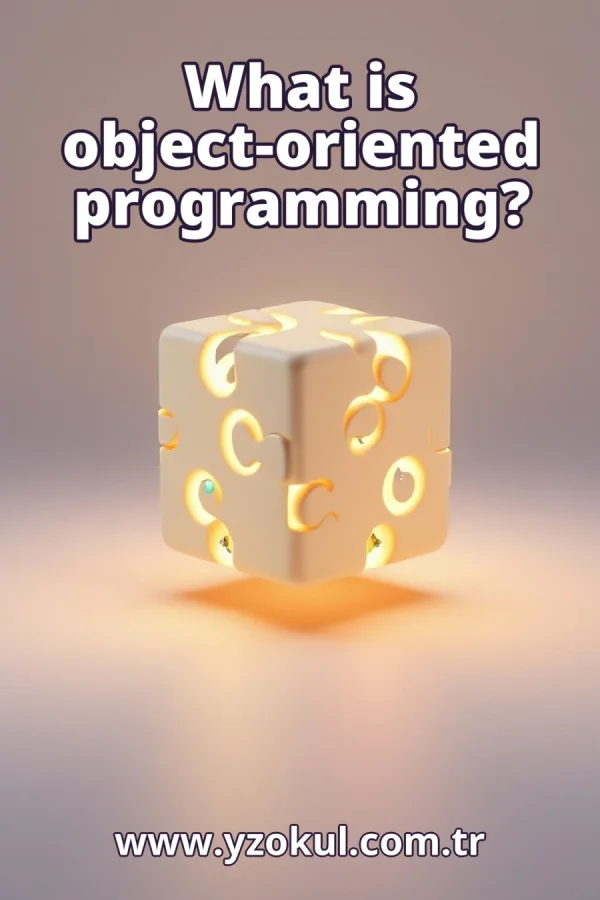
What is object-oriented programming?
www.yzokul.com.tr
- Category AI Resources
- Format PDF
- Size 6.4 MB
- Added 01.11.2026
- Views 2
This book answers the question of what object-oriented programming is, explaining it from zero for complete beginners. It follows a path that presents object-oriented programming as an approach organizing data and behavior around objects, using a game character example where health, position, and movement are handled together. It explains how classes define the common structure of objects and how this helps divide complex programs into understandable parts. It also notes that this is not mandatory or best for every problem, and that other programming approaches exist.
Read the Book
If the PDF does not appear, open it in a new tab.
A Chapter from the Book
What is object-oriented programming? www.yzokul.com.tr
You may have heard the term object-oriented programming and wondered what it means. The short answer: it is a way of organizing a program so that data and the actions on that data are grouped together around objects. You do not need any prior knowledge to follow the rest of this explanation. Everything is built from zero, one idea at a time. 1
Every program holds some data and performs some actions on that data. Imagine a simple program that stores a number as data and has an action that adds one to it. The data sits in one place, and the action sits in another. Keeping them separate works for tiny programs, but it becomes harder as programs grow. This separation is the starting point for understanding why objects help. 2
When data and the actions that use it are kept far apart in a program, it becomes hard to see which action belongs to which data. You may have many actions and many pieces of data, and nothing shows how they connect. A change in one place can break something far away. This drift makes programs confusing to read and risky to modify, especially when many people work on the same code. 3
Consider a character in a game as a running example. This character has health, which is a number showing how much damage it can take. It has a position, which tells where it stands on the game map. It also has a movement behavior, an action that changes its position. These three things belong together, and you will see them grouped in the next pages. 4
Keep the character's health, position, and movement behavior together in one place. Health is data, position is data, and movement is an action that uses both. This bundle of data and actions is what we call an object. Instead of scattering these pieces across the program, the object holds them as one unit. The character object is your concrete picture of this idea. 5
An object holds its own data and the operations that work on that data. The character object stores its health and position, and it also contains the movement action that reads and changes the position. You do not need to search elsewhere for the action that belongs to the data. The object keeps them together, so you always know where to look. 6
Imagine several characters in the game. Each one has its own health value and its own position on the map. Yet they all share the same kind of structure: each has health, position, and a movement action. They are separate objects, but they follow the same pattern. This shared pattern is what a class describes, as you will see next. 7
A class describes the common structure of objects. It lists which data the objects have, such as health and position, and which actions they can do, such as movement. The class is the pattern or blueprint; the objects are made from it. You write the class once, and it defines the shape that every character object will follow. This keeps the definition in one place. 8
Each character object is created from the class and gets its own values. One object may have health 100 and position 3, another health 50 and position 7. They share the same structure from the class but hold different data. One class, many objects, each with its own health and position. This is how a class saves you from repeating the same structure for every character. 9
To understand a character, you look in one place: its object. Its data and actions are not scattered across the program. If you want to know how movement works, you check the object that contains the movement action. If you want to know a character's health, you check the same object. This single place to look makes reading and changing the program much easier. 10
A large program can be divided into understandable parts, each built around its own objects. Instead of one huge list of data and actions, you have a character object, a weapon object, a map object, and so on. Each part has a clear job. The goal is to make complex programs easier to grasp piece by piece, rather than as one tangled whole. 11
The understandable parts work together to form the whole program. Each object handles its own job, and the parts connect through simple actions. The character object moves, the map object shows the position, and the weapon object deals damage. No part needs to know everything about the others. This connection of small, clear parts is how objectoriented programming builds a complete program. 12
Object-oriented programming is not required and not the best method for every problem. Some problems are handled more simply with other approaches. For a small script that adds numbers, creating objects may add unnecessary complexity. The approach is a tool, not a rule. You choose it when grouping data and actions around objects makes the program clearer, not just because it exists. 13
There are different programming approaches besides objectoriented programming. Some organize a program as a list of instructions, step by step. Others focus on functions that transform data. Knowing this keeps the idea in perspective: object-oriented programming is one way among several. Each approach has strengths, and the right choice depends on the problem you are solving and the clarity you need.
This section is a preview taken from the book (about 913 words). To continue, read the book or download the PDF.
Book Details
- Book
- What is object-oriented programming?
- Author
- www.yzokul.com.tr
- Category
- AI Resources
- Language
- English
- Format
- PDF · 6.4 MB
- Pages
- 18
- Words
- about 1,044
- Published
- kaynak.yzokul.com.tr · 01.11.2026
- Access
- Free to read and download; for personal use only, all rights belong to the author.
Frequently Asked Questions
Is the PDF of What is object-oriented programming? free?
Yes. What is object-oriented programming? can be read and downloaded for free on this site; no sign-up or payment is required.
How many pages is What is object-oriented programming??
What is object-oriented programming? has 18 pages and about 1,044 words.
Which devices can I read What is object-oriented programming? on?
It is a PDF; you can read it in your browser on a phone, tablet or computer, or download it and open it offline.
Who is the author of What is object-oriented programming??
What is object-oriented programming? was written by www.yzokul.com.tr; it is listed in the AI Resources category.
Similar Books
 Why is HTTPS used?
www.yzokul.com.tr
 Is every algorithm a computer program?
www.yzokul.com.tr
 What is artificial intelligence?
www.yzokul.com.tr
 Is there a difference between coding and programming?
www.yzokul.com.tr
 How does an app idea turn into a working program?
www.yzokul.com.tr
 What is the difference between virtual reality and augmented reality?
www.yzokul.com.tr