
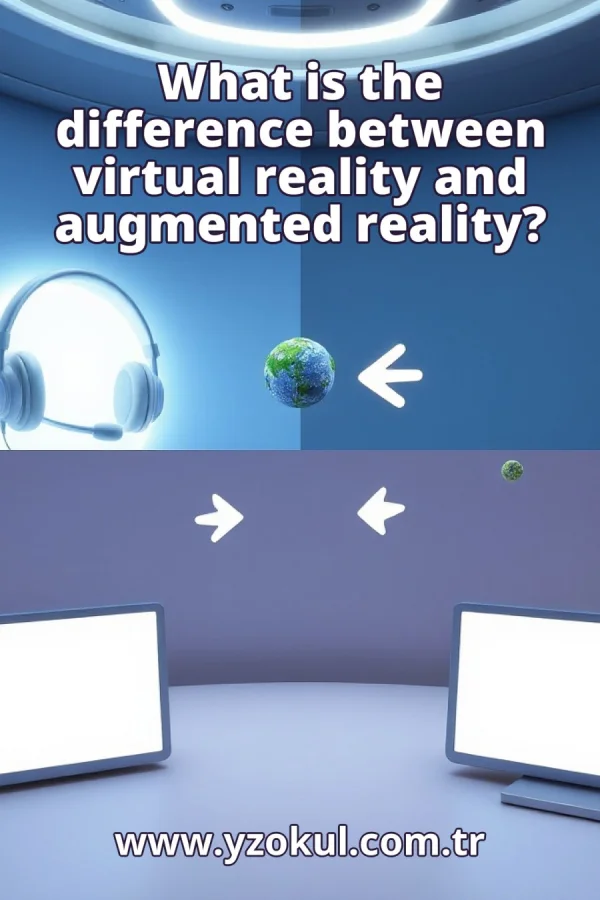
What is the difference between virtual reality and augmented reality?
www.yzokul.com.tr
- Category AI Resources
- Format PDF
- Size 7.7 MB
- Added 01.11.2026
- Views 2
This educational answer book explains the difference between virtual reality and augmented reality for complete beginners. It answers the question by following a simple path: virtual reality puts the user inside a computer generated world, while augmented reality adds digital elements to a real world image. Using clear examples like a virtual space station, it shows how the two experiences differ. It also explains that position tracking is important in both, and that latency and image accuracy affect quality. Everything is explained from zero, assuming no prior knowledge.
Read the Book
If the PDF does not appear, open it in a new tab.
A Chapter from the Book
What is the difference between virtual reality and augmented reality? www.yzokul.com.tr
You have a question: what is the difference between virtual reality and augmented reality? The short answer is that virtual reality puts you inside a computer-made world, while augmented reality adds digital things to the real world you see. This book explains that difference step by step, using simple examples. You do not need any prior knowledge to follow along. 1
Reality means the world around you that you see and hear. Both technologies change what you see, but they change it in different ways. Virtual reality replaces your view of the real world with a computer-made one. Augmented reality keeps your view of the real world and adds digital elements on top. Understanding this basic idea helps you see the difference. 2
A computer can create pictures, sounds, and moving images. These computer-made things can be shown to you through a screen or a headset. When you look at a screen, you see what the computer displays. A headset is a device you wear on your head that shows images directly to your eyes. Both are ways to see computer-made content. 3
Virtual reality (VR) shows you a world mostly created by a computer. When you wear the headset, you see that made world instead of the room around you. The computer generates everything you see: landscapes, objects, and even the sky. Your real room is hidden from view. This is what makes virtual reality feel like a different place. 4
Augmented reality (AR) keeps the real world in view and adds digital elements on top of it. You still see your room, but a digital object appears inside it. For example, you might see a digital planet sitting on your table. The computer uses a camera to see the real world and then places digital things into the picture. This mixes real and digital. 5
Picture walking around inside a completely virtual space station. Everything you see there is made by the computer: the walls, the controls, and the view of space outside. Your real room is hidden from view. You can move around and explore this made world. This is a virtual reality experience because the real world is replaced. 6
Picture a digital planet appearing inside your real room. You can still see your room and furniture, but the planet is added on top of them. The planet looks like it is really there, floating in your room. You can walk around it and see it from different angles. This is an augmented reality experience because the real world stays visible. 7
Compare the two pictures side by side. In virtual reality, the real room is replaced by a computer-made world. In augmented reality, the real room stays and digital things are added. The space station example shows replacement, while the planet-in-room example shows addition. This is the main difference between the two technologies. 8
Learn a simple rule: virtual reality replaces what you see, augmented reality adds to what you see. This rule covers the main difference in one sentence. Whenever you are unsure, ask yourself: does this technology replace my view or add to it? If it replaces, it is virtual reality. If it adds, it is augmented reality. 9
Both technologies need to know where you are and how you move. This is called position tracking. Position tracking uses sensors to detect your head movements and your location. Motion tracking is similar and detects how you move. With tracking, the computer can change the picture as you turn your head or walk, making the experience feel real. 10
In virtual reality, tracking keeps the made world lined up with your movements. When you turn your head, the virtual view turns with you so it feels real. If you walk forward, the virtual world moves as if you are walking in it. Good tracking makes you feel like you are really inside the computer-made world. 11
In augmented reality, tracking keeps the digital object in the right place in your real room. If you move, the added object stays fixed where it should be. For example, the digital planet stays on your table even when you walk around it. Good tracking makes the digital object look like it is really part of your room. 12
Latency is the short delay between your movement and the picture changing. Low latency makes the experience feel smooth, while high latency makes it feel slow and wrong. If you turn your head and the picture lags behind, you may feel uncomfortable. Both virtual reality and augmented reality need low latency to feel natural. 13
Image accuracy means the picture matches what it should look like. If the image is inaccurate, the virtual world or the added digital object looks wrong or out of place. For example, a digital planet might look flat or the wrong color. Accurate images make the experience believable and help you see the digital elements clearly. 14
Check common mix-ups. Some people think augmented reality replaces the real world, but it adds to it. Others think virtual reality adds things to your room, but it replaces your view. Remember: virtual reality replaces, augmented reality adds, and both need good tracking, low latency, and accurate images. Avoid these mistakes to understand the difference clearly. 15
Sum up the answer: virtual reality puts you inside a computermade world, and augmented reality adds digital elements to the real world. Both depend on position tracking to respond to your movements. Latency and image accuracy affect how good the experience feels. With this simple rule and these key points, you can now explain the difference to others.
This section is a preview taken from the book (about 949 words). To continue, read the book or download the PDF.
Book Details
- Book
- What is the difference between virtual reality and augmented reality?
- Author
- www.yzokul.com.tr
- Category
- AI Resources
- Language
- English
- Format
- PDF · 7.7 MB
- Pages
- 18
- Words
- about 950
- Published
- kaynak.yzokul.com.tr · 01.11.2026
- Access
- Free to read and download; for personal use only, all rights belong to the author.
Frequently Asked Questions
Is the PDF of What is the difference between virtual reality and augmented reality? free?
Yes. What is the difference between virtual reality and augmented reality? can be read and downloaded for free on this site; no sign-up or payment is required.
How many pages is What is the difference between virtual reality and augmented reality??
What is the difference between virtual reality and augmented reality? has 18 pages and about 950 words.
Which devices can I read What is the difference between virtual reality and augmented reality? on?
It is a PDF; you can read it in your browser on a phone, tablet or computer, or download it and open it offline.
Who is the author of What is the difference between virtual reality and augmented reality??
What is the difference between virtual reality and augmented reality? was written by www.yzokul.com.tr; it is listed in the AI Resources category.
Similar Books
 What is artificial intelligence?
www.yzokul.com.tr
 How does an app idea turn into a working program?
www.yzokul.com.tr
 How does a three-dimensional printer produce a model?
www.yzokul.com.tr
 What is simulation?
www.yzokul.com.tr
 How does a robot find the shortest path?
www.yzokul.com.tr
 How does a robot follow a line?
www.yzokul.com.tr