
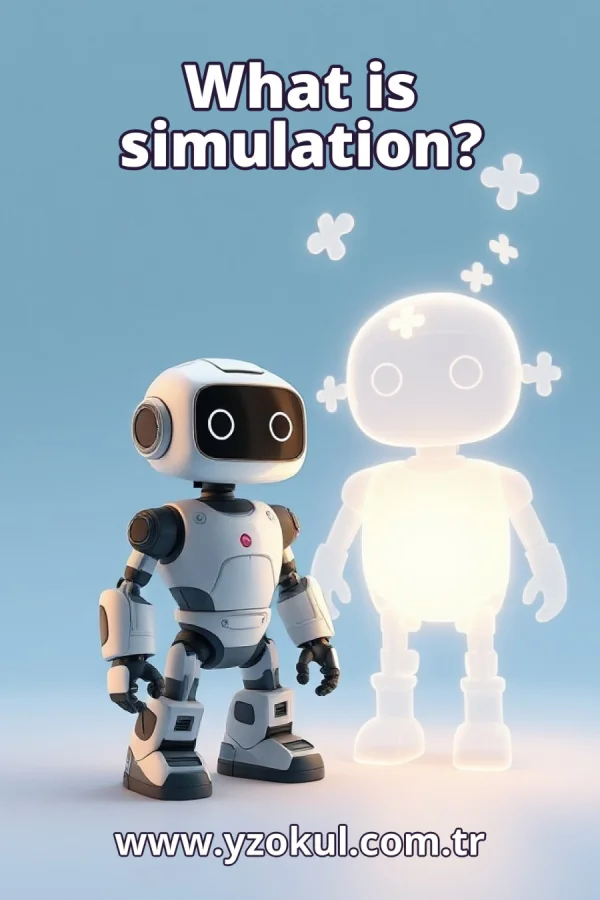
What is simulation?
www.yzokul.com.tr
- Category AI Resources
- Format PDF
- Size 7.1 MB
- Added 01.11.2026
- Views 2
This book answers the question what simulation is for complete beginners. It follows the path of explaining simulation as imitating the behavior of a real or imaginary system through a model, such as testing a robot on a computer before building it. It shows that results depend on the model's rules and assumptions, that simulation makes experiments cheaper and safer, and that real world effects missing from the model can make simulated success differ from real results.
Read the Book
If the PDF does not appear, open it in a new tab.
A Chapter from the Book
What is simulation? www.yzokul.com.tr
You ask a simple question: what is simulation? The short answer is that simulation means imitating how a real or imaginary system behaves by using a model. A model is a simplified stand-in for the system you want to study. The whole book unpacks this one sentence, one idea at a time, so you can understand simulation from zero. 1
A system is just a set of parts that work together toward some behavior. A robot is a system: its parts include motors, wheels, sensors and a control program. A factory is also a system, with machines and workers linked together. Simulation always starts by naming which system you want to study, because the model must copy that system's behavior. 2
A model is a simplified stand-in for the system, not the system itself. Picture a real robot next to a smaller drawing of the same robot; the drawing is a model. The model keeps the features you care about and leaves out the rest. You work with the model because it is easier to handle than the full real thing. 3
Simulation is not just a picture of a system; it is a copy of how the system acts over time. The model must reproduce the steps or movements of the real system, moment after moment. A picture of a robot shows its shape, but a simulation shows the robot moving, turning and stopping. Behavior over time is the heart of simulation. 4
A system can be something that exists, like a robot in a lab, or something only imagined, like a planned machine that has never been built. Simulation works for both cases because it only needs a model, not the real thing. If you can describe the rules of the system, you can simulate it, whether it exists yet or not. 5
Walk through the book's example: you want to try out a robot's movement on a computer before building the physical robot. The computer version can be tested without any metal, motors or wheels. You run it, watch the robot move on screen, and adjust the design. Only after the design looks good do you spend money on real parts. 6
Every model contains rules that decide how it behaves. For the robot, the rules might say how fast it moves, how sharply it turns, and how far its sensor can see. These rules are written by the person who builds the model. Change a rule, and the simulated robot behaves differently. 7
A model also carries assumptions, which are choices made on purpose to keep the model simple. You might assume the ground is flat, the robot is always balanced, and there is no wind. These assumptions are not errors; they are deliberate simplifications. They let you focus on the behavior you care about without modeling everything. 8
The simulation's output is shaped by its rules and assumptions, not by magic. If you set the robot's speed rule higher, it travels farther in the same time. If you assume flat ground, it never tips over. Changing one rule or one assumption can change the result, so the output always reflects the model you built. 9
Simulation can make experiments cheaper because you do not need to build or buy the real system. Trying many robot versions on a computer costs far less than building many physical robots. You can test ten designs in an afternoon without ordering a single part. Money and materials are saved, and you can still learn which design works best. 10
Simulation can also make experiments safer because dangerous tests happen in the model, not in the real world. Suppose you want to test a robot near a hot surface or on a steep slope. Running that test on a computer means nobody gets hurt and nothing gets damaged. Risky ideas can be explored freely inside the model. 11
The real world has effects the model may leave out, like uneven ground, wind, dust or temperature. If your model assumes flat ground, it never sees the bumps your real robot will meet. These missing effects are the reason simulation is not the same as reality. A good simulation user always asks what was left out. 12
A solution that works in simulation may not give the same result in the real environment. Picture a robot that walks perfectly across the screen but stumbles on a real carpet. The model did not include the carpet's softness, so its success was only true inside the model. Simulated success is a strong hint, not a guarantee. 13
A common mistake is treating simulation results as the final truth. Results are only as good as the model's rules and assumptions, so a perfect score on screen proves little by itself. Use simulation to explore and compare, then check important findings against reality. Trust the model for guidance, not for certainty. 14
Another common mistake is forgetting that you are watching a model, not the system itself. Always ask which rules and assumptions were left out of the model. A beautiful animation can hide a missing effect, like friction or battery drain. Remembering the model keeps you honest about what the simulation really shows. 15
Simulation imitates a system's behavior through a model, which makes experiments cheaper and safer but depends on the model's rules and assumptions. Missing real-world effects can make simulated success differ from real results. Use simulation to explore many ideas quickly, then check the best ones in the real world. That balance is the practical answer to what simulation is.
This section is a preview taken from the book (about 932 words). To continue, read the book or download the PDF.
Book Details
- Book
- What is simulation?
- Author
- www.yzokul.com.tr
- Category
- AI Resources
- Language
- English
- Format
- PDF · 7.1 MB
- Pages
- 18
- Words
- about 933
- Published
- kaynak.yzokul.com.tr · 01.11.2026
- Access
- Free to read and download; for personal use only, all rights belong to the author.
Frequently Asked Questions
Is the PDF of What is simulation? free?
Yes. What is simulation? can be read and downloaded for free on this site; no sign-up or payment is required.
How many pages is What is simulation??
What is simulation? has 18 pages and about 933 words.
Which devices can I read What is simulation? on?
It is a PDF; you can read it in your browser on a phone, tablet or computer, or download it and open it offline.
Who is the author of What is simulation??
What is simulation? was written by www.yzokul.com.tr; it is listed in the AI Resources category.
Similar Books
 What is a microcontroller?
www.yzokul.com.tr
 How does two-step verification work?
www.yzokul.com.tr
 What is the difference between a hash function and encryption?
www.yzokul.com.tr
 How does encryption work?
www.yzokul.com.tr
 What does JavaScript do on a web page?
www.yzokul.com.tr
 Why is HTTPS used?
www.yzokul.com.tr