
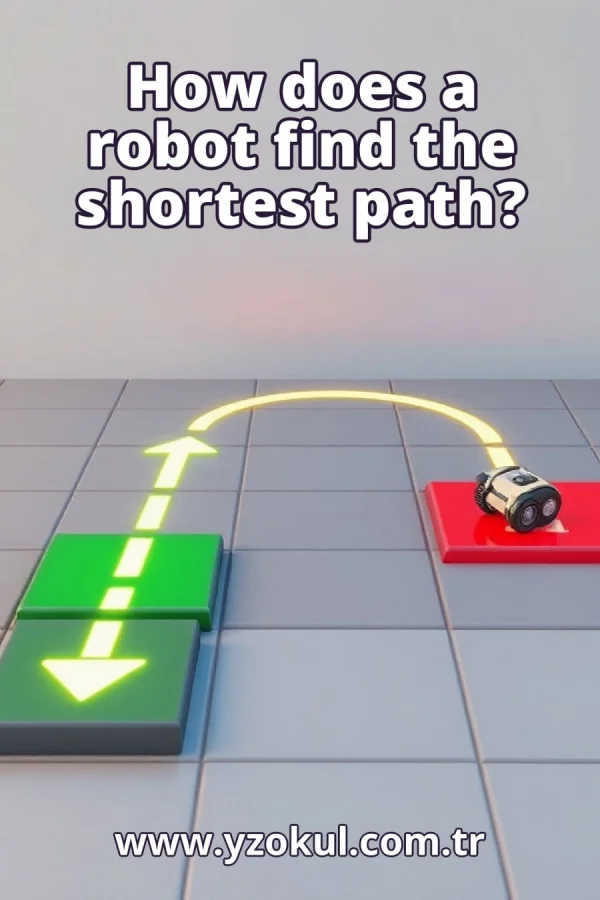
How does a robot find the shortest path?
www.yzokul.com.tr
- Category AI Resources
- Format PDF
- Size 8.2 MB
- Added 01.11.2026
- Views 2
This book answers the question of how a robot finds the shortest path. It starts from zero and explains robot pathfinding in plain language. First, the environment is drawn as a grid map with passable points and connections, and blocked cells are avoided. Next, a pathfinding algorithm compares the options from start to target. The book shows that shortest can mean least distance, time or energy, and that a robot must recalculate its path when the environment changes.
Read the Book
If the PDF does not appear, open it in a new tab.
A Chapter from the Book
How does a robot find the shortest path? www.yzokul.com.tr
A robot that moves from one place to another needs to know the best way to go. The question is how it finds the shortest path. The short answer: the robot draws the world as a map, then uses a step-by-step method to compare routes from start to goal. This book explains each part in plain language. 1
Picture the robot as a small dot on a floor plan. It must travel from a start point to a goal point. A path is simply the list of places the dot passes through on the way. For example, the path might be: start cell, then right, right, up, up, goal cell. The robot's job is to find a good list. 2
The robot's world is drawn as a grid of small square cells, like a chessboard. Each cell is either free to enter or blocked. A free cell might be open floor; a blocked cell might be a table or a wall. For example, a 5 by 5 grid can represent a small room with a table in the middle. 3
Mark which cells the robot can stand on and which neighboring cells it can move between. These passable points and connections together form the map the robot reasons about. For example, two free cells side by side are connected; a free cell next to a blocked cell has no connection there. The robot only moves along connections. 4
Blocked cells are simply not allowed in any route. The robot only steps through free cells that are connected to each other. For example, if a wall blocks a corridor, the robot must go around it through other free cells. It never tries to pass through a blocked cell, because that would be impossible or unsafe. 5
Place a start cell and a goal cell on the grid. Often there are many possible routes between them. For example, in an open grid you can go right then up, or up then right, or take a longer zigzag. The robot's job is to pick one route, ideally the shortest according to some measure. 6
An algorithm is a clear list of steps the robot follows without guessing. It looks at the options from the start toward the goal and keeps track of the best route found so far. For example, a simple algorithm might check all neighbors of the start cell, then all neighbors of those, and so on until it reaches the goal. 7
The algorithm looks at neighboring cells one at a time and compares which route is cheaper so far. It expands outward from the start until it reaches the goal. For example, it might first look at cells one step away, then two steps away, always keeping the cheapest known route to each cell. This systematic comparison finds the best route. 8
Each move between cells has a cost, and adding up the costs gives the total cost of a route. The robot prefers the route with the smallest total cost. For example, if each step costs 1, a route with 5 steps costs 5. A route with 7 steps costs 7, so the robot prefers the 5-step route. 9
One meaning of shortest is the fewest steps or the smallest total distance traveled. On a grid, this is often just counting how many cell-to-cell moves a route needs. For example, moving right then up takes 2 steps; moving right, right, up, up takes 4 steps. The robot picks the route with fewer steps. 10
Shortest can also mean the fastest route, where some moves take longer than others. The robot then adds up travel times instead of distances. For example, moving over a rough patch might take 3 seconds per cell, while smooth floor takes 1 second. A longer route on smooth floor could be faster overall. 11
Shortest can mean using the least energy. For example, going uphill or over rough ground costs more energy than going downhill or on smooth ground. The robot sums energy costs along each route and picks the cheapest. A route that is longer in distance might use less energy if it avoids steep climbs. 12
The robot must know which measure matters before it searches. The same map can give different best routes depending on whether distance, time, or energy is counted. For example, the shortest distance route might go through mud, while the lowest energy route goes around it. You must tell the robot which cost to minimize. 13
A new obstacle can block the chosen route after the robot has started. Then the old route is no longer valid and the robot must search again. For example, if a box is placed in the corridor, the robot detects it and recalculates a new path around the box. This keeps the robot safe and on track. 14
Check typical beginner errors: forgetting blocked cells, mixing up the three measures, or trusting an old route after the map changes. Each mistake leads to a wrong or unsafe path. For example, ignoring a blocked cell might make the robot try to walk through a wall. Always update the map and recheck the cost measure. 15
Map the world as passable points and connections, avoid blocked cells, and let an algorithm compare route costs. Remember that shortest depends on the chosen measure: distance, time, or energy. When the environment changes, recalculate the path. For example, a delivery robot in a warehouse uses these ideas to find the fastest safe route to a shelf.
This section is a preview taken from the book (about 929 words). To continue, read the book or download the PDF.
Book Details
- Book
- How does a robot find the shortest path?
- Author
- www.yzokul.com.tr
- Category
- AI Resources
- Language
- English
- Format
- PDF · 8.2 MB
- Pages
- 18
- Words
- about 930
- Published
- kaynak.yzokul.com.tr · 01.11.2026
- Access
- Free to read and download; for personal use only, all rights belong to the author.
Frequently Asked Questions
Is the PDF of How does a robot find the shortest path? free?
Yes. How does a robot find the shortest path? can be read and downloaded for free on this site; no sign-up or payment is required.
How many pages is How does a robot find the shortest path??
How does a robot find the shortest path? has 18 pages and about 930 words.
Which devices can I read How does a robot find the shortest path? on?
It is a PDF; you can read it in your browser on a phone, tablet or computer, or download it and open it offline.
Who is the author of How does a robot find the shortest path??
How does a robot find the shortest path? was written by www.yzokul.com.tr; it is listed in the AI Resources category.
Similar Books
 What is artificial intelligence?
www.yzokul.com.tr
 How does an app idea turn into a working program?
www.yzokul.com.tr
 How does a three-dimensional printer produce a model?
www.yzokul.com.tr
 What is simulation?
www.yzokul.com.tr
 What is the difference between a microcontroller and a normal computer?
www.yzokul.com.tr
 What is a microcontroller?
www.yzokul.com.tr