
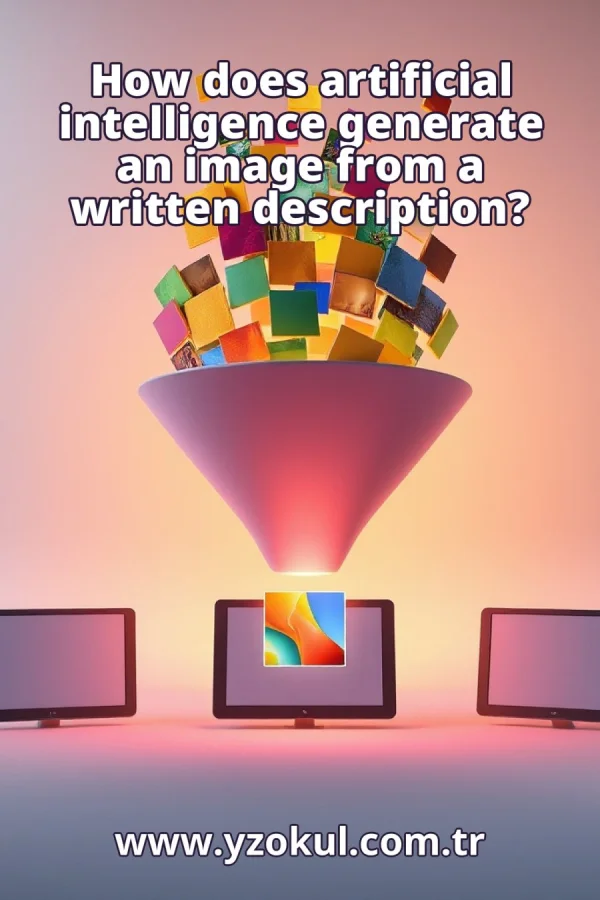
How does artificial intelligence generate an image from a written description?
www.yzokul.com.tr
- Category AI Resources
- Format PDF
- Size 6.7 MB
- Added 01.11.2026
- Views 2
This book answers the question of how artificial intelligence generates an image from a written description. It follows the path of explaining, from zero for complete beginners, that image generation models learn the relationships between texts and images during training, that the user's description guides the process through these relationships, and that some models produce a result by gradually refining a noisy image. It also notes that the generated image is not guaranteed to be physically or historically accurate.
Read the Book
If the PDF does not appear, open it in a new tab.
A Chapter from the Book
How does artificial intelligence generate an image from a written description? www.yzokul.com.tr
You type a written description, and artificial intelligence produces a matching image. The short answer: the model learned links between texts and images during training, and your words steer it through those links. This book explains each part step by step, from zero. You will see how words become numbers, how training builds connections, and how a picture is made. 1
A computer sees an image as a grid of tiny colored dots called pixels. Each pixel is stored as numbers that describe its color and brightness. So an entire image is just a large set of numbers arranged in rows and columns. When you look at a photo, the computer sees only these numbers, not the scene. 2
A computer sees your written description as a list of words. Each word is turned into a list of numbers, often called a vector, so the computer can process it. The same happens with images: they become numbers too. Now both text and images are numbers, and the model can compare them and find patterns. 3
During training, the model is shown millions of pairs: an image and a description of that image. By seeing many such pairs, it learns which words tend to go with which pictures. For example, it sees many images labeled with words like dog or sunset. Over time, it picks up the statistical relationships between texts and images. 4
The model gradually adjusts its internal numbers so that matching text and image pairs end up close together in its representation. This is how it stores the relationships between words and pictures. When a word and an image often appear together, their number patterns become similar. These learned links are the core of how the model connects your words to visual content. 5
When you type a description, the model turns it into numbers and uses the learned links to decide what the image should contain. Your description acts like a set of instructions or a guide. For instance, if you write a red car, the model's internal numbers for red and car pull the image toward those features. The words steer the generation process. 6
Some models begin with a random noisy image, like static on a screen. This noise is just random numbers. The task is to turn that noise into a picture that fits your description. Starting from noise ensures the model creates a new image rather than copying an existing one. The noise is the raw material. 7
The model cleans up the noisy image in many small steps. At each step, it removes a bit of noise, guided by your description. So the picture slowly appears, becoming clearer and more detailed. Each step is a small adjustment based on what the model thinks the image should look like to match your words. 8
Consider the description a ship sailing in moonlight. The word ship influences the model to create a boat-like shape. Moonlight suggests dark blue and silver colors and a night setting. The model combines these cues from its training to form a coherent scene. The words guide the choice of objects, colors, and atmosphere. 9
Words like ship and moonlight pull the image toward certain shapes and colors that the model learned during training. The model picks what fits best based on those learned associations. For example, ship is linked to hulls and sails, while moonlight is linked to pale light and dark skies. The model balances all word influences to produce a single image. 10
After many refining steps, the noise becomes a clear picture. The result is one image that the model judged to match your description. The model stops when it has removed most of the noise and the image looks like a plausible match. You see the final image, which is the model's best effort at following your words. 11
The generated image is not guaranteed to be physically or historically accurate. It matches patterns from training, not real-world facts. For example, it might show a ship with impossible rigging or moonlight in the wrong direction. The model aims for plausibility based on its training data, not for truth. Always check important details. 12
A common mistake is to think the model searches for an existing photo. It does not look anything up; it builds a new image from learned patterns. There is no database of images it retrieves from. Instead, it generates pixels step by step, guided by your description and its training. The result is novel, not a copy. 13
Another mistake is to believe the model truly understands words the way people do. It works with number patterns learned from many examples, not real comprehension. It does not know what a ship is in a human sense; it only knows which visual features tend to accompany the word ship in its training data. Its understanding is statistical, not conceptual. 14
The same description does not always give the same image. Because some models start from random noise, results can differ each time. Even small changes in the starting noise lead to different final images. So if you generate a ship in moonlight twice, you may get two different pictures. This variability is normal and expected. 15
Training teaches text-image links, your description guides the process, and some models refine noise step by step. Remember the result follows learned patterns, not guaranteed accuracy. The model does not look up or truly understand; it generates based on statistical associations. With this knowledge, you can better interpret and use AI-generated images.
This section is a preview taken from the book (about 937 words). To continue, read the book or download the PDF.
Book Details
- Book
- How does artificial intelligence generate an image from a written description?
- Author
- www.yzokul.com.tr
- Category
- AI Resources
- Language
- English
- Format
- PDF · 6.7 MB
- Pages
- 18
- Words
- about 938
- Published
- kaynak.yzokul.com.tr · 01.11.2026
- Access
- Free to read and download; for personal use only, all rights belong to the author.
Frequently Asked Questions
Is the PDF of How does artificial intelligence generate an image from a written description? free?
Yes. How does artificial intelligence generate an image from a written description? can be read and downloaded for free on this site; no sign-up or payment is required.
How many pages is How does artificial intelligence generate an image from a written description??
How does artificial intelligence generate an image from a written description? has 18 pages and about 938 words.
Which devices can I read How does artificial intelligence generate an image from a written description? on?
It is a PDF; you can read it in your browser on a phone, tablet or computer, or download it and open it offline.
Who is the author of How does artificial intelligence generate an image from a written description??
How does artificial intelligence generate an image from a written description? was written by www.yzokul.com.tr; it is listed in the AI Resources category.
Similar Books
 What is artificial intelligence?
www.yzokul.com.tr
 How does an app idea turn into a working program?
www.yzokul.com.tr
 How does a three-dimensional printer produce a model?
www.yzokul.com.tr
 What is simulation?
www.yzokul.com.tr
 What is the difference between a microcontroller and a normal computer?
www.yzokul.com.tr
 What is a microcontroller?
www.yzokul.com.tr