
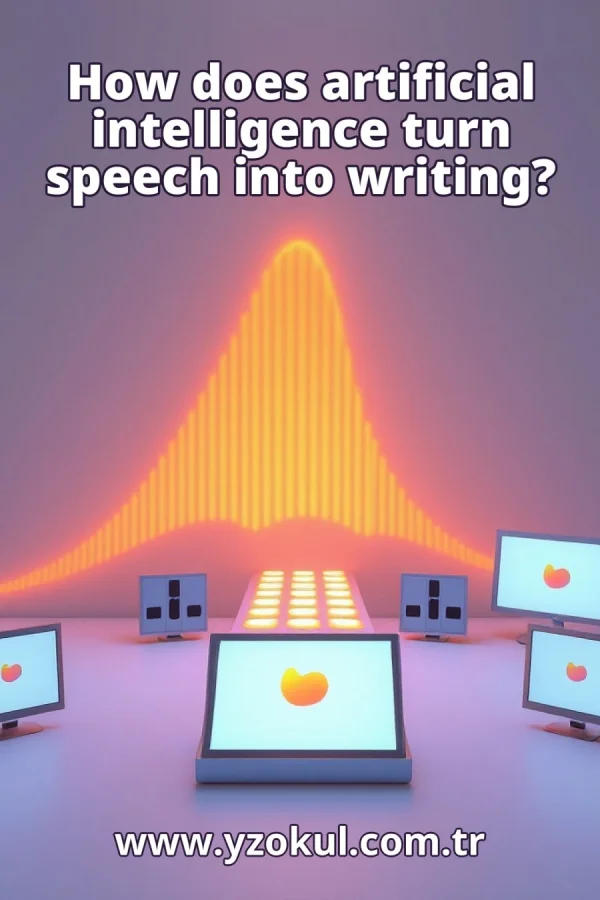
How does artificial intelligence turn speech into writing?
www.yzokul.com.tr
- Category AI Resources
- Format PDF
- Size 6.9 MB
- Added 01.11.2026
- Views 2
This book answers how artificial intelligence turns speech into writing. It explains from zero how speech recognition works: a microphone records sound waves, and the system converts them into numerical features. From these features, it predicts sounds and possible words. Sentence context helps distinguish similar-sounding words, so the system can complete likely sentences even when syllables are lost in noise. Accents, voice quality, and several people speaking at once can affect accuracy. The book follows this clear path, making the topic easy for complete beginners to understand.
Read the Book
If the PDF does not appear, open it in a new tab.
A Chapter from the Book
How does artificial intelligence turn speech into writing? www.yzokul.com.tr
Artificial intelligence turns speech into writing by capturing sound with a microphone, converting that sound into numbers, and then predicting sounds and words from those numbers. The system does not listen like a person; it works on patterns in the numbers. This book explains each part of that path step by step, from the first sound wave to the final written text. You will see how features, word prediction, and sentence context work together. 1
Speech is a vibration of air that travels as a sound wave. When you speak, your voice makes the air around your mouth vibrate, and these vibrations move outward. A microphone catches that wave and turns it into an electrical signal. This signal can be stored and later used by a computer. Understanding that sound is a wave helps you see what the microphone actually records. 2
A microphone records a person speaking and saves the sound as a digital file. The microphone turns the air vibrations into an electrical signal, and the computer stores that signal as a sequence of numbers. This recording is the raw material the system starts with. Without a clear recording, the later steps have less to work with. The digital file holds the whole sound, ready to be analyzed. 3
The computer cannot use the sound wave directly, so it measures the wave many times per second. Each measurement becomes a number, and the speech becomes a long list of numbers. This process is called sampling. The list of numbers represents how the air pressure changed over time. From this point on, the system works only with numbers, not with the original wave. 4
The system does not keep every raw number but extracts useful patterns called features. Features describe the important qualities of the sound in a compact way, such as how energy is spread across different frequencies. Frequency means how fast the air vibrates. By focusing on features, the system reduces a huge list of numbers to a smaller set that captures what matters for recognizing speech. 5
From the features, the system predicts which small sounds were spoken. These small sound units are the building blocks of spoken words. The system compares the features to patterns it has learned from many examples of speech. For each moment in the recording, it estimates the most likely sound. These predicted sounds are not yet words, but they are the first step toward them. 6
The predicted sounds are combined into possible words. The system lists the words that best match the sequence of sounds it detected. It uses a model of how sounds typically form words in the language. For example, a sequence of sounds might match several words, so the system keeps candidates. This word prediction turns a stream of sounds into a set of word choices. 7
Similar sounds can point to several different words. The system keeps more than one candidate and weighs which ones are more likely. For example, the sounds for two and too are the same, so the system must decide from other clues. It does not commit to one word immediately. Instead, it holds several options and waits for more evidence from the sentence. 8
The surrounding words in a sentence help pick the right word. For example, context can tell apart two words that sound almost the same, such as write and right. If the previous words are about putting words on paper, the system favors write. Sentence context acts like a guide that narrows down the choices. This is how the system uses more than just sound to decide. 9
Even when syllables are lost in noise, the system tries to complete the most likely sentence. It uses what fits best with the words around the gap. For example, if part of a word is hidden by a cough, the system may still guess the intended word from the rest of the sentence. This filling in relies on learned patterns of how sentences usually go. It helps keep the written text readable. 10
Once the words are chosen, the system writes them out as text. The final output is the written version of what was spoken. The text appears in order, word by word, as the system decides. This written text is what you see on the screen. The whole process, from sound wave to text, is now complete for that piece of speech. 11
Different accents and voice qualities can make recognition harder. The system may need to handle many ways of pronouncing the same words. An accent changes how sounds are produced, and voice quality includes things like pitch and roughness. The system learns from many examples, but unfamiliar accents can still cause errors. Accuracy depends on how well the system has been trained on similar voices. 12
When several people speak at the same time, the sounds mix and accuracy can drop. Overlapping voices are a hard case for the system because the features from different speakers combine. The system may struggle to separate the words of one person from another. In such situations, the written text may contain mistakes or missing words. This is one reason why clear, single-speaker speech works best. 13
Background noise can hide parts of the speech. The system relies on context to fill in what it could not hear clearly. For example, if a passing truck drowns out a syllable, the system may still guess the word from the sentence. Noise makes the features less clear, so the system has to work harder. Context and word prediction help, but some errors may remain.
This section is a preview taken from the book (about 942 words). To continue, read the book or download the PDF.
Book Details
- Book
- How does artificial intelligence turn speech into writing?
- Author
- www.yzokul.com.tr
- Category
- AI Resources
- Language
- English
- Format
- PDF · 6.9 MB
- Pages
- 18
- Words
- about 1,062
- Published
- kaynak.yzokul.com.tr · 01.11.2026
- Access
- Free to read and download; for personal use only, all rights belong to the author.
Frequently Asked Questions
Is the PDF of How does artificial intelligence turn speech into writing? free?
Yes. How does artificial intelligence turn speech into writing? can be read and downloaded for free on this site; no sign-up or payment is required.
How many pages is How does artificial intelligence turn speech into writing??
How does artificial intelligence turn speech into writing? has 18 pages and about 1,062 words.
Which devices can I read How does artificial intelligence turn speech into writing? on?
It is a PDF; you can read it in your browser on a phone, tablet or computer, or download it and open it offline.
Who is the author of How does artificial intelligence turn speech into writing??
How does artificial intelligence turn speech into writing? was written by www.yzokul.com.tr; it is listed in the AI Resources category.
Similar Books
 What is artificial intelligence?
www.yzokul.com.tr
 How does an app idea turn into a working program?
www.yzokul.com.tr
 How does a three-dimensional printer produce a model?
www.yzokul.com.tr
 What is simulation?
www.yzokul.com.tr
 What is the difference between a microcontroller and a normal computer?
www.yzokul.com.tr
 What is a microcontroller?
www.yzokul.com.tr