
What is a table in a relational database?
www.yzokul.com.tr
- Category AI Resources
- Format PDF
- Size 8.1 MB
- Added 01.11.2026
- Views 2
This beginner-friendly answer book explains what a table is in a relational database. It answers the question by describing how a table organizes data in rows and columns, where columns represent types of information and rows represent records. Using a student table as an example, it shows how columns for name, number and class work. It then explains how different tables link through keys, reducing unnecessary repetition of information and creating consistent connections between data. The path moves from basic structure to practical example to linking tables.
Read the Book
If the PDF does not appear, open it in a new tab.
A Chapter from the Book
What is a table in a relational database? www.yzokul.com.tr
You see the question: what is a table in a relational database? The short answer is that a table organizes data into rows and columns. Think of it as a structured grid that holds information in a clear, predictable way. This answer book explains each part step by step, starting with the basic idea and building up to how tables connect to each other. 1
A database is a place where a lot of information is stored together in an organized way. A table is one organized part inside that place, like a single sheet in a larger notebook. For example, a school database might hold one table for students, another for classes, and another for teachers. Each table keeps its own kind of information separate and tidy. 2
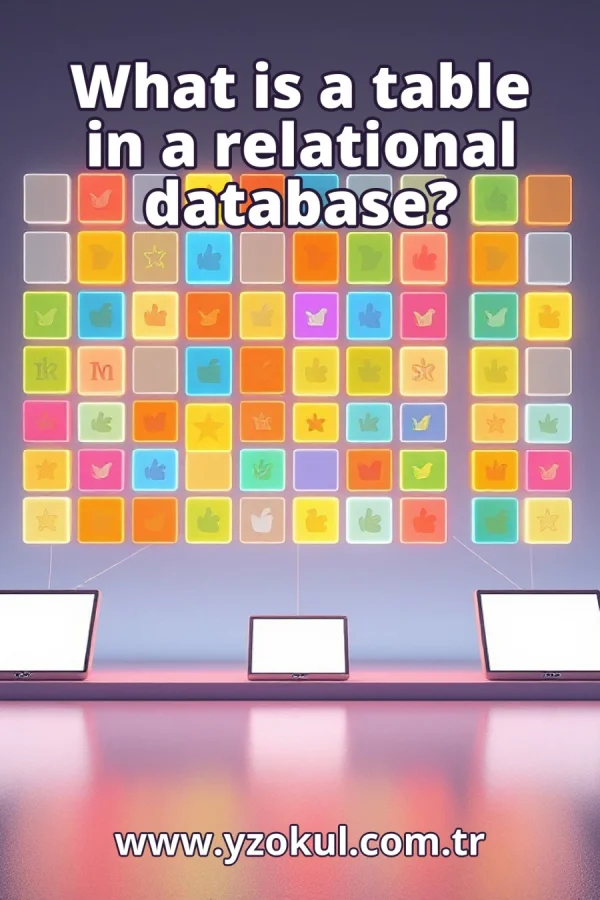
Picture a table as a simple grid of boxes, like a sheet of paper with lines drawn on it. The grid has columns going down from top to bottom and rows going across from left to right. Each small box where a column and row meet holds one piece of information. This grid shape is what makes a table easy to read and understand. 3
Each column holds one type of information, and every box in that column describes the same kind of thing. For example, one column might hold only names, and another column might hold only numbers. A column is like a labeled category that tells you what kind of data goes in it. This keeps information consistent and easy to find. 4
Each row is one record, meaning one complete item of information. A row collects one piece of each column together into a single line. For example, one row might hold one student's name, that student's number, and that student's class. A record is simply one full set of related details about a single thing. 5
Meet the student table, a beginner-friendly example. It has a column for name, a column for number, and a column for class. Each column holds only that type of information: names in the name column, numbers in the number column, and classes in the class column. This table stores details about many students in one organized place. 6
Read one row of the student table from left to right. It gives the name, number, and class of one single student. For example, a row might read: Anna, 101, Class A. That one line tells you three facts about one student. Reading a row is how you look up a complete record. 7
Read one column top to bottom. You see that every entry in the name column is a name, and every entry in the class column is a class. For example, the class column might list Class A, Class B, and Class A again. A column groups the same kind of information together so you can compare entries easily. 8
The grid keeps information tidy and easy to find. You can look up one student by following their row across the table. If you need all the names, you read down the name column. Rows and columns work together so you can find one record or compare one type of information without confusion. 9
A relational database usually has several tables, not just one. Each table can hold a different kind of information. For example, one table might hold students, another might hold classes, and another might hold teachers. Keeping different kinds of information in separate tables makes the database easier to manage and understand. 10
Tables can be linked through special columns called keys. A key is a value that identifies a record so another table can point to it. For example, each class in a class table might have a class number that acts as its key. The student table can then store that class number to point to the right class. 11
See a class table linked to the student table by a key. The class table might hold a class number, a class name, and a teacher name. The student table stores only the class number, not the class name or teacher. That number points to the full class details in the class table. 12
Linking through keys avoids writing the same information again and again. The class details are stored once in the class table and shared by every student who points to that class. For example, if ten students are in Class A, the class name and teacher are written only once. This saves space and reduces mistakes. 13
Keys keep the connections between data consistent. If a class detail changes, it changes in one place and every link still works. For example, if the teacher for Class A changes, you update the class table once. Every student row that points to that class automatically shows the correct, updated detail. 14
Avoid confusing rows with columns: rows are records going across, and columns are types of information going down. Do not repeat the same information in many tables; link through keys instead. Also remember that a key must identify a record clearly, so each key value should be unique and never ambiguous. 15
Sum up the answer: a table is a grid of rows and columns, columns are types of information, rows are records, and keys link tables to reduce repetition. Remember these four points. For example, the student table shows columns for name, number, and class, rows for each student, and a class key linking to the class table.
This section is a preview taken from the book (about 925 words). To continue, read the book or download the PDF.
Book Details
- Book
- What is a table in a relational database?
- Author
- www.yzokul.com.tr
- Category
- AI Resources
- Language
- English
- Format
- PDF · 8.1 MB
- Pages
- 18
- Words
- about 926
- Published
- kaynak.yzokul.com.tr · 01.11.2026
- Access
- Free to read and download; for personal use only, all rights belong to the author.
Frequently Asked Questions
Is the PDF of What is a table in a relational database? free?
Yes. What is a table in a relational database? can be read and downloaded for free on this site; no sign-up or payment is required.
How many pages is What is a table in a relational database??
What is a table in a relational database? has 18 pages and about 926 words.
Which devices can I read What is a table in a relational database? on?
It is a PDF; you can read it in your browser on a phone, tablet or computer, or download it and open it offline.
Who is the author of What is a table in a relational database??
What is a table in a relational database? was written by www.yzokul.com.tr; it is listed in the AI Resources category.
Similar Books
 What is artificial intelligence?
www.yzokul.com.tr
 How does an app idea turn into a working program?
www.yzokul.com.tr
 How does a three-dimensional printer produce a model?
www.yzokul.com.tr
 What is simulation?
www.yzokul.com.tr
 What is the difference between a microcontroller and a normal computer?
www.yzokul.com.tr
 What is a microcontroller?
www.yzokul.com.tr