
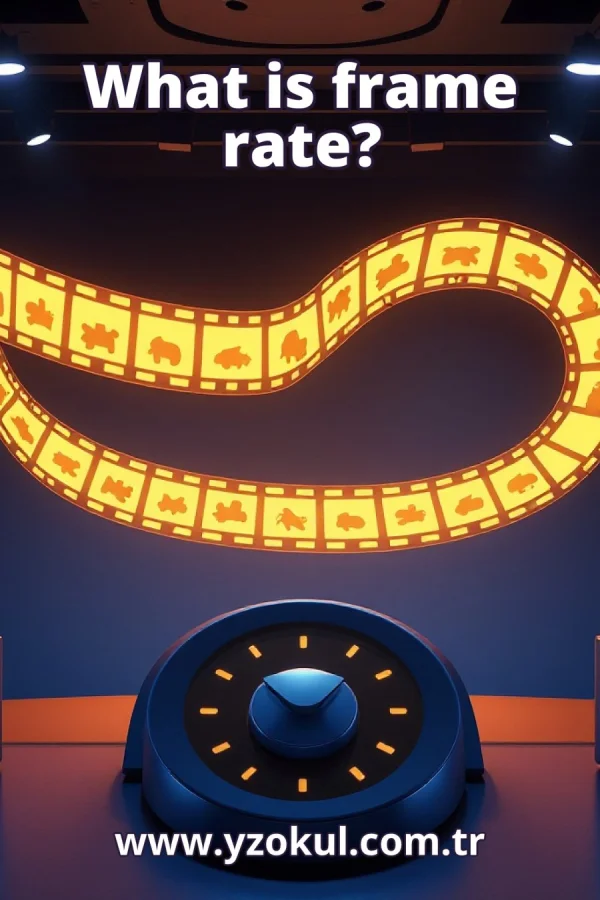
What is frame rate?
www.yzokul.com.tr
- Category AI Resources
- Format PDF
- Size 7.4 MB
- Added 01.11.2026
- Views 2
This book answers the question of what frame rate is. It explains that frame rate means the number of images shown or produced per second, written as FPS. It follows a path from this basic definition to why a higher frame rate can make motion look smoother. It also notes that smooth motion depends on the screen's refresh rate, the display arrangement, and regular frame production, since long pauses can cause stutter even when the average is high.
Read the Book
If the PDF does not appear, open it in a new tab.
A Chapter from the Book
What is frame rate? www.yzokul.com.tr
What is frame rate? The short answer is that frame rate is the number of images shown or produced per second. It is written as FPS, which stands for frames per second. For example, a video with a frame rate of 30 FPS shows 30 images every second. This number tells you how many pictures appear in each second of motion. 1
Moving pictures are really many still pictures shown one after another quickly. Your eye blends them into motion. For example, a video of a running dog is actually a series of photos of the dog in slightly different positions. When shown fast enough, you see smooth movement instead of separate pictures. The speed of showing these pictures is what frame rate measures. 2
Frame rate simply counts how many of these still pictures appear each second. Ten pictures per second means a frame rate of 10 FPS. For example, if you count 24 images in one second of video, the frame rate is 24 FPS. This count is the basic definition of frame rate, and it applies to videos, games, and any moving images. 3
FPS stands for frames per second. It is just the short way of writing the frame rate number. For example, instead of saying the frame rate is 60 frames per second, you can say it is 60 FPS. The label FPS is used everywhere, from video game settings to camera specifications. It always means the same thing: images per second. 4
Picture a flipbook where each page is one frame. Flipping more pages per second is the same idea as a higher frame rate. For example, if you flip 10 pages in one second, you see a simple animation. If you flip 30 pages in one second, the motion looks smoother. The number of pages flipped per second is like the frame rate. 5
With few pictures per second, motion looks choppy. The gaps between images are easy to notice. For example, a video at 5 FPS shows only 5 images each second, so a moving ball may appear to jump from place to place. Your eye sees the separate pictures instead of smooth motion. Low frame rates make movement look jumpy and less realistic. 6
More pictures per second fill in the motion better. This is why a higher frame rate can make movement look smoother. For example, a video at 60 FPS shows 60 images each second, so a running person looks more fluid than at 15 FPS. The extra images reduce the gaps your eye notices. A higher frame rate helps motion appear more continuous. 7
The screen also has its own rate of updating, called the refresh rate. Smooth motion depends on this too, not only on the frame rate. For example, if your screen refreshes 60 times per second but the video is 120 FPS, the screen can only show 60 of those frames. The refresh rate limits how smooth the motion can look, so both numbers matter. 8
The display arrangement also affects what you see. Frame rate alone does not decide how smooth the motion looks. For example, how the screen is set up, such as its resolution and how it handles motion, can change your perception. A high frame rate on a poor display may not look as smooth as expected. The whole display system works together. 9
Frames need to be produced at a steady pace. It is not only the average number that counts. For example, a game might average 60 FPS but produce some frames quickly and then pause. That uneven timing can be noticeable. Regular frame production means each frame arrives at a consistent interval, which helps motion look smooth. 10
If there are long pauses between frames, the motion can stutter. This can happen even when the average frame rate is high. For example, a video might average 60 FPS but have a half-second pause where no new frames appear. During that pause, the image freezes, and then it jumps. That freeze is called stutter, and it breaks smooth motion. 11
A high average number can hide uneven timing. The picture may still look jumpy because some frames arrive late. For example, a game might show 60 FPS on average but have several long gaps in one second. Those gaps cause visible stutter even though the average is high. The average alone does not tell you if the motion is smooth. 12
A common mistake is thinking that a higher FPS always means perfectly smooth motion. The refresh rate, the display arrangement, and regular timing also matter. For example, a 120 FPS video on a 60 Hz screen may not look smoother than 60 FPS because the screen cannot show all frames. Smoothness depends on the whole system, not just the frame rate number. 13
Another common mistake is looking only at the average frame rate. Long pauses between frames can cause stutter even with a high average. For example, a game might report 60 FPS but have a one-second freeze every few seconds. The average stays high, but you see the stutter. Always consider the timing of frames, not just the average. 14
Remember to check all the pieces together: the frame rate, the screen's refresh rate, the display arrangement, and steady frame timing. For example, a game at 60 FPS on a 60 Hz screen with regular frames will look smooth. If any piece is off, motion may not be smooth. All these parts work together to create the final picture you see.
This section is a preview taken from the book (about 930 words). To continue, read the book or download the PDF.
Book Details
- Book
- What is frame rate?
- Author
- www.yzokul.com.tr
- Category
- AI Resources
- Language
- English
- Format
- PDF · 7.4 MB
- Pages
- 18
- Words
- about 989
- Published
- kaynak.yzokul.com.tr · 01.11.2026
- Access
- Free to read and download; for personal use only, all rights belong to the author.
Frequently Asked Questions
Is the PDF of What is frame rate? free?
Yes. What is frame rate? can be read and downloaded for free on this site; no sign-up or payment is required.
How many pages is What is frame rate??
What is frame rate? has 18 pages and about 989 words.
Which devices can I read What is frame rate? on?
It is a PDF; you can read it in your browser on a phone, tablet or computer, or download it and open it offline.
Who is the author of What is frame rate??
What is frame rate? was written by www.yzokul.com.tr; it is listed in the AI Resources category.
Similar Books
 What is artificial intelligence?
www.yzokul.com.tr
 How does an app idea turn into a working program?
www.yzokul.com.tr
 How does a three-dimensional printer produce a model?
www.yzokul.com.tr
 What is simulation?
www.yzokul.com.tr
 What is the difference between a microcontroller and a normal computer?
www.yzokul.com.tr
 What is a microcontroller?
www.yzokul.com.tr