
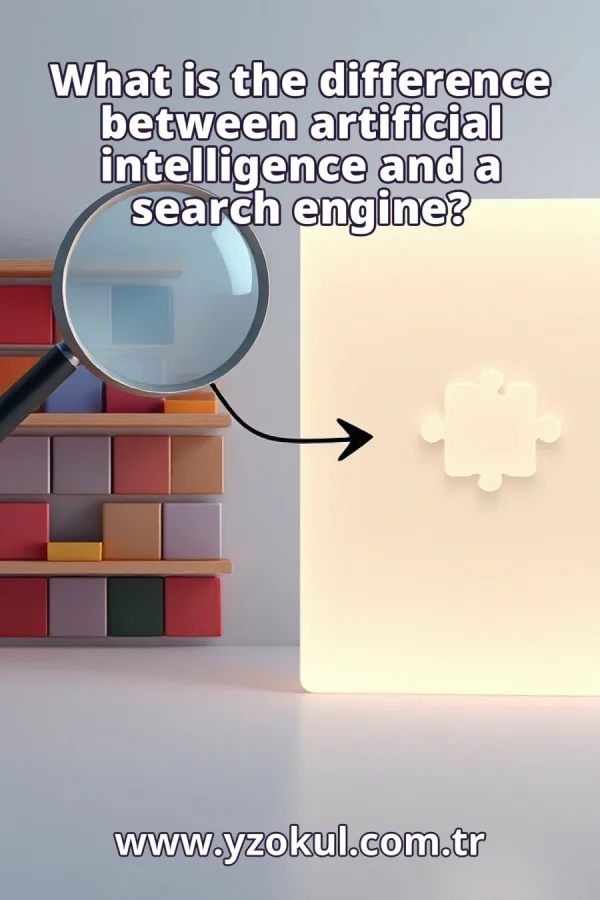
What is the difference between artificial intelligence and a search engine?
www.yzokul.com.tr
- Category AI Resources
- Format PDF
- Size 5.9 MB
- Added 01.11.2026
- Views 2
This beginner-friendly book explains the difference between artificial intelligence and a search engine. It answers the question by showing that a search engine finds and ranks sources, while generative AI creates a new answer from context. The book follows a simple path: it separates finding sources from generating answers, notes that some tools combine both steps, and teaches readers to evaluate source currency and whether answers match their sources. Written for complete beginners with no prior knowledge, it uses plain language throughout.
Read the Book
If the PDF does not appear, open it in a new tab.
A Chapter from the Book
What is the difference between artificial intelligence and a search engine? www.yzokul.com.tr
You may wonder what the difference is between artificial intelligence and a search engine. The short answer is that a search engine finds and ranks sources, while generative AI creates a new answer from the context it is given. These are two different jobs. One points you to pages; the other writes sentences for you. Keeping this contrast in mind makes the rest clear. 1
A search engine is a tool that looks through many pages and records for things related to your query. Its job is to find and rank those sources, not to write a new answer for you. When you type words into the search box, it returns a list of results ordered by relevance. It does not compose an explanation; it points you toward pages that might contain one. 2
A typical search results page shows a list of links, titles, and short snippets. Each link points to a source you can open and read. The list does not answer your question directly; it shows you where answers may be found. You still have to click, open, and read the pages yourself. The search engine has done the finding, not the explaining. 3
Generative AI is a tool that writes a new answer based on the context it is given. Instead of handing you a list of links, it produces sentences that respond to your question. It creates this text fresh each time, using patterns learned from many examples. The output is a written answer, not a set of sources to visit. This is the key difference from a search engine. 4
A generated answer appears as a block of plain text written for your question. This text is newly made; it is not a copy of one page you could click. It may be fluent and well organized, but it is still a new composition. You cannot open it as a source because it is not a source. You must treat it as an answer to check, not as a page to read. 5
Place the two side by side: finding and ranking sources on one side, creating a new answer on the other. A search engine finds and ranks; generative AI creates. This single contrast is the heart of the difference. Everything else follows from it. When you know which job a tool is doing, you know what to expect from its output. 6
A list of links and a generated answer are not the same thing. One points you toward sources; the other gives you finished sentences you must still check. A link list says here are places to look. A generated answer says here is what I think. You respond to each differently: you open links, and you verify generated text against sources. 7
Some applications combine the two functions. First they find sources, then they write an explanation based on those sources. These tools perform a search step and a writing step inside one interface. You see a written answer, but behind it there was a search. Knowing this helps you ask where the answer came from and which sources it used. 8
Follow a combined tool through its two steps. The search step gathers sources related to your query. The writing step then explains those sources in plain sentences. Both steps happen inside one application, so the answer and the sources appear together. You can often see the sources listed next to the answer. This lets you trace the written text back to what it used. 9
Ask where a generated answer came from and which sources it used. A combined tool can show you its sources, so you can trace the answer back. Look for links or citations beside the answer. If no sources are shown, you cannot tell what the answer is based on. Tracing the answer back is the first habit to build when using any AI tool. 10
Check how old or current the sources are. A source that is out of date can make even a well-written answer unreliable. Open the sources and look for dates, editions, or version numbers. Ask whether the information could have changed since then. Source currency is a separate question from how smooth the answer reads. 11
Compare the generated answer with the sources it claims to use. The answer should conform to those sources; that is, it should say what they say. Read the source and check whether the answer matches it. Look for claims in the answer that the source does not support. This check is separate from checking the sources themselves. 12
Source currency and answer conformity are two different questions. You evaluate them one at a time instead of assuming a good answer means good sources. First ask whether the sources are current. Then ask whether the answer matches those sources. A current source can still be misread, and a matching answer can still rest on old sources. Check each separately. 13
A common mistake is treating a fluent generated answer as automatically correct. Smooth writing is not proof that the answer matches real sources. Generated text can sound confident while being wrong or unsupported. Do not let good grammar convince you. Treat every generated answer as a claim to verify, not as a fact to accept. 14
Another common mistake is ignoring the links a tool provides. Open the sources and check them rather than stopping at the written answer. The links are there so you can verify. Skipping them means you never confirm that the answer is grounded. Make opening the sources a habit, even when the answer looks complete and convincing.
This section is a preview taken from the book (about 950 words). To continue, read the book or download the PDF.
Book Details
- Book
- What is the difference between artificial intelligence and a search engine?
- Author
- www.yzokul.com.tr
- Category
- AI Resources
- Language
- English
- Format
- PDF · 5.9 MB
- Pages
- 18
- Words
- about 1,010
- Published
- kaynak.yzokul.com.tr · 01.11.2026
- Access
- Free to read and download; for personal use only, all rights belong to the author.
Frequently Asked Questions
Is the PDF of What is the difference between artificial intelligence and a search engine? free?
Yes. What is the difference between artificial intelligence and a search engine? can be read and downloaded for free on this site; no sign-up or payment is required.
How many pages is What is the difference between artificial intelligence and a search engine??
What is the difference between artificial intelligence and a search engine? has 18 pages and about 1,010 words.
Which devices can I read What is the difference between artificial intelligence and a search engine? on?
It is a PDF; you can read it in your browser on a phone, tablet or computer, or download it and open it offline.
Who is the author of What is the difference between artificial intelligence and a search engine??
What is the difference between artificial intelligence and a search engine? was written by www.yzokul.com.tr; it is listed in the AI Resources category.
Similar Books
 What is artificial intelligence?
www.yzokul.com.tr
 How does an app idea turn into a working program?
www.yzokul.com.tr
 How does a three-dimensional printer produce a model?
www.yzokul.com.tr
 What is simulation?
www.yzokul.com.tr
 What is the difference between a microcontroller and a normal computer?
www.yzokul.com.tr
 What is a microcontroller?
www.yzokul.com.tr