
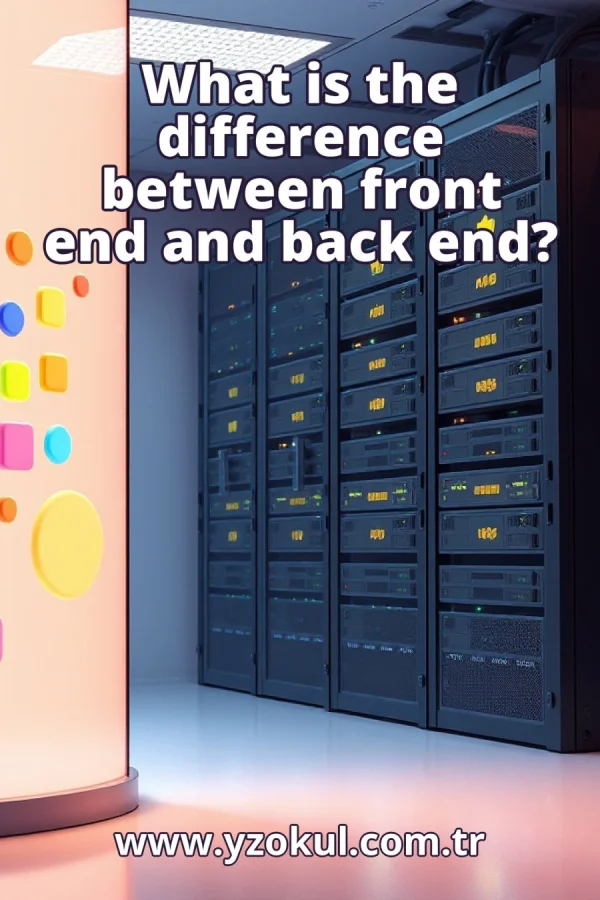
What is the difference between front end and back end?
www.yzokul.com.tr
- Category AI Resources
- Format PDF
- Size 7.8 MB
- Added 01.11.2026
- Views 2
This beginner-friendly book answers the question of how front end and back end differ. It follows a clear path: first it explains that the front end is everything the user sees and interacts with, then it describes the back end as the server side that handles data processing, record management, and business rules. A simple login example shows the two parts working together over a network. Written for complete beginners with no prior knowledge, it explains every term from zero in plain language.
Read the Book
If the PDF does not appear, open it in a new tab.
A Chapter from the Book
What is the difference between front end and back end? www.yzokul.com.tr
The question is simple: what is the difference between front end and back end? The short answer is that the front end is everything the user sees and touches on a screen, such as buttons, text, and images. The back end is the server side that does hidden work like data processing, record management, and business rules. The two parts work together, and this book explains each one step by step. 1
The front end means everything a user sees and interacts with on a screen. It is the visible part of an application, like the buttons you click, the text you read, and the pictures you look at. When you open an app or a website, the front end is what appears in front of you. It is built to be clear and easy to use, so you can find what you need and take action. 2
The back end is the part that runs on a server, away from the user's screen. You do not see it, but it does important work behind the scenes. It handles tasks like storing information, checking rules, and preparing data. The back end makes sure everything runs correctly even though the user never watches it directly. It is the hidden engine that supports what you see. 3
A server is a computer that runs the back end and answers requests. It is not your own device like your phone or laptop; it is a separate machine that serves many users at the same time. When you click a button, your device sends a request to the server, and the server sends back an answer. Servers are built to stay on and handle many requests reliably. 4
Picture a screen with buttons, text, and images. Everything visible and clickable belongs to the front end. For example, a shopping app shows a list of products with pictures and prices, and a button that says add to cart. All of these elements are part of the front end, designed to help you see information and take action easily. 5
Now picture the hidden side: the server doing work the user never watches. The back end stays out of sight while the user only sees results on screen. For example, when you tap add to cart, the front end shows a small confirmation, but behind the scenes the back end records the item in your cart. You see the result, not the work. 6
The back end can process data, for example adding up numbers or sorting a list. This work happens on the server, not on the visible screen. For instance, a banking app might calculate your total spending for the month on the back end and then send the result to the front end to display. Data processing keeps the heavy work away from your device. 7
The back end can store and manage records, like a list of users or orders. Keeping and finding these records is a back end job. For example, when you create an account, the back end saves your name and email in a database, which is an organized collection of records. Later, when you log in, the back end finds your record and checks it. 8
The back end enforces rules, such as who is allowed to do what. These rules are decided on the server, not on the user's screen. For example, a rule might say that only an administrator can delete a user account. The back end checks the rule before allowing the action, so the rule cannot be bypassed by changing something on the front end. 9
A login form appears on the front end. It has a name field, a password field, and a button. This is where the user types and clicks. The form is designed to be simple and clear, so you know where to enter your information. Everything you see and interact with on this form is part of the front end. 10
The typed password goes to the back end, where it is checked. The check happens on the server, so the user never sees the stored password. For example, the back end compares the typed password with the stored one and sends back a message that says whether the login is correct. The front end then shows that message on the screen. 11
Front end and back end communicate over a network. The front end sends a request, and the back end sends back an answer. For example, when you submit a login form, the front end sends your name and password to the server. The back end checks them and replies with a success or failure message, which the front end displays. 12
The split of tasks can vary depending on the application. Some apps do more on the front end, others more on the back end, but the two parts still work together. For example, a simple calculator might do all the math on the front end, while a banking app does the math on the back end for security. The balance changes, but the partnership remains. 13
A common mistake is to think one side is more important. Both front end and back end are needed, and each does its own job. Without the front end, you would have no way to see or use the app. Without the back end, there would be no safe place to store data or enforce rules. They depend on each other.
This section is a preview taken from the book (about 923 words). To continue, read the book or download the PDF.
Book Details
- Book
- What is the difference between front end and back end?
- Author
- www.yzokul.com.tr
- Category
- AI Resources
- Language
- English
- Format
- PDF · 7.8 MB
- Pages
- 18
- Words
- about 1,048
- Published
- kaynak.yzokul.com.tr · 01.11.2026
- Access
- Free to read and download; for personal use only, all rights belong to the author.
Frequently Asked Questions
Is the PDF of What is the difference between front end and back end? free?
Yes. What is the difference between front end and back end? can be read and downloaded for free on this site; no sign-up or payment is required.
How many pages is What is the difference between front end and back end??
What is the difference between front end and back end? has 18 pages and about 1,048 words.
Which devices can I read What is the difference between front end and back end? on?
It is a PDF; you can read it in your browser on a phone, tablet or computer, or download it and open it offline.
Who is the author of What is the difference between front end and back end??
What is the difference between front end and back end? was written by www.yzokul.com.tr; it is listed in the AI Resources category.
Similar Books
 What is artificial intelligence?
www.yzokul.com.tr
 How does an app idea turn into a working program?
www.yzokul.com.tr
 How does a three-dimensional printer produce a model?
www.yzokul.com.tr
 What is simulation?
www.yzokul.com.tr
 What is the difference between a microcontroller and a normal computer?
www.yzokul.com.tr
 What is a microcontroller?
www.yzokul.com.tr