
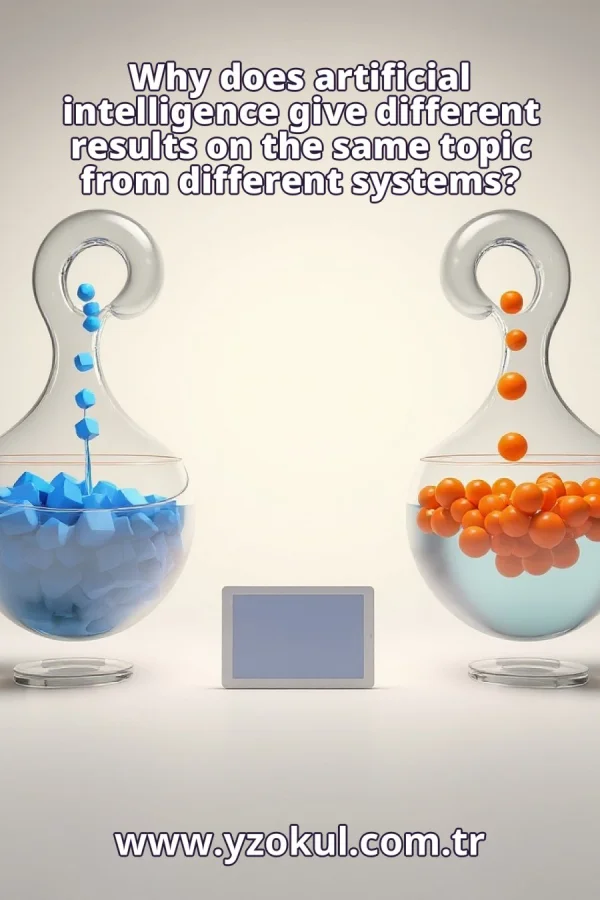
Why does artificial intelligence give different results on the same topic from different systems?
www.yzokul.com.tr
- Category AI Resources
- Format PDF
- Size 6.4 MB
- Added 01.11.2026
- Views 2
This beginner-friendly book explains why different artificial intelligence systems can give different answers about the same topic. It answers that question by showing that systems differ in their training data, model structure, goals, and settings, and that some use external sources while others rely only on the given context. Using simple examples, it also explains that such differences are often not intentional and that fair comparison requires the same task, the same data, and suitable success measures.
Read the Book
If the PDF does not appear, open it in a new tab.
A Chapter from the Book
Why does artificial intelligence give different results on the same topic from different systems? www.yzokul.com.tr
You ask two AI systems the same question and get two different answers. The short answer is that systems differ in what they learned from, how they are built, what they aim for, and how they are used. Each of those differences can change the output, even when the topic is identical. This book explains each cause step by step, using plain examples, so you can see why different results are normal rather than mysterious. 1
An AI system is a computer program that produces outputs such as text, labels, or answers. It does this by finding patterns in examples it was trained on, not by understanding the world the way a person does. It has no beliefs, memories, or intentions of its own. When you type a question, the program calculates a likely response from what it learned. That is why its answer depends heavily on its training and design. 2
Each system learns from its own collection of examples, called training data. One system may have read many science articles, another many news stories, and a third many forum posts. What a system has seen shapes what it says, because it repeats patterns from that material. Two systems fed different material will naturally respond differently to the same question. The training data is often the single largest reason for different results. 3
Systems are built with different internal designs and sizes, often called the model structure. Think of different kinds of engines: a small engine and a large engine both move a car, but they behave differently. The same input passes through different structures and can come out differently. A larger structure may capture finer patterns, while a smaller one may generalize more simply. Structure shapes the answer before any settings are applied. 4
Systems are tuned toward different aims, called objectives. One may be tuned to be brief, another to be cautious, and another to be creative. These aims push the same question toward different answers. A cautious system may add warnings, while a creative one may offer unusual ideas. The objective is set during development and acts like a guiding preference. It is not a mood and does not change from question to question. 5
Settings and usage also change outputs. Length limits, tone options, and safety filters can all shift what a system says. The same system can even answer differently depending on how it is set up or how you phrase the request. For example, asking for one sentence versus a full page produces different text from the identical model. Settings are like adjusting a camera before taking a picture: the scene is the same, the result is not. 6
Some systems look things up in outside sources, such as websites or databases, while others rely only on what is in front of them. A system with external sources can bring in fresh facts; one without them must answer from its learned patterns alone. This difference alone can make two systems give different answers to the same question. Neither approach is automatically better; each has trade-offs in freshness and reliability. 7
A system working only from the provided context cannot use anything beyond it. If you paste a short paragraph and ask a question, the answer must come from that paragraph and the system's training. If the context is thin, the answer will reflect that limit. Two systems given the same thin context may still differ, but both are constrained by what they were handed. Context is a boundary, not a suggestion. 8
Imagine one photo of a dog shown to two image-classifying systems. The first labels it as a wolf; the second labels it as a dog. Same photo, two results. This simple example makes the abstract idea of differing systems concrete and visible. You can see that the difference did not come from the photo changing. It came from the systems themselves, which read the same pixels in different ways. 9
Each system learned different links between features and labels. One may have learned that pointed ears and a certain coat mean wolf, while the other learned that the same features mean dog. Each reads the photo its own way, based on its own training examples. Neither is necessarily trying to be difficult; they simply learned differently. The learned relationships are the system's internal rules, built from data rather than written by hand. 10
Differences usually come from data, design, goals, and settings, not from a system deciding to disagree. An AI has no intention to be stubborn or tricky. It produces the output its training and configuration make most likely. When two systems differ, the cause is almost always in how they were made and used. Removing the idea of intent helps you judge the results calmly and compare them fairly. 11
Comparing systems casually is unfair, like racing cars on different tracks. If one system gets a longer prompt, fresher data, or a different task, the comparison tells you little. To judge which is better, the conditions must be the same for every system. Fair comparison is a controlled experiment, not a quick glance at two answers. Without control, differences may come from the setup rather than the systems. 12
A fair comparison gives every system exactly the same task. Write one clear instruction and use it for all systems without changes. If you ask one system to summarize and another to explain, the results are not comparable. Changing the task between systems makes the results meaningless. Fix the task first, then run every system on it, and record the outputs in the same way.
This section is a preview taken from the book (about 950 words). To continue, read the book or download the PDF.
Book Details
- Book
- Why does artificial intelligence give different results on the same topic from different systems?
- Author
- www.yzokul.com.tr
- Category
- AI Resources
- Language
- English
- Format
- PDF · 6.4 MB
- Pages
- 18
- Words
- about 1,161
- Published
- kaynak.yzokul.com.tr · 01.11.2026
- Access
- Free to read and download; for personal use only, all rights belong to the author.
Frequently Asked Questions
Is the PDF of Why does artificial intelligence give different results on the same topic from different systems? free?
Yes. Why does artificial intelligence give different results on the same topic from different systems? can be read and downloaded for free on this site; no sign-up or payment is required.
How many pages is Why does artificial intelligence give different results on the same topic from different systems??
Why does artificial intelligence give different results on the same topic from different systems? has 18 pages and about 1,161 words.
Which devices can I read Why does artificial intelligence give different results on the same topic from different systems? on?
It is a PDF; you can read it in your browser on a phone, tablet or computer, or download it and open it offline.
Who is the author of Why does artificial intelligence give different results on the same topic from different systems??
Why does artificial intelligence give different results on the same topic from different systems? was written by www.yzokul.com.tr; it is listed in the AI Resources category.
Similar Books
 What is artificial intelligence?
www.yzokul.com.tr
 How does an app idea turn into a working program?
www.yzokul.com.tr
 How does a three-dimensional printer produce a model?
www.yzokul.com.tr
 What is simulation?
www.yzokul.com.tr
 What is the difference between a microcontroller and a normal computer?
www.yzokul.com.tr
 What is a microcontroller?
www.yzokul.com.tr