
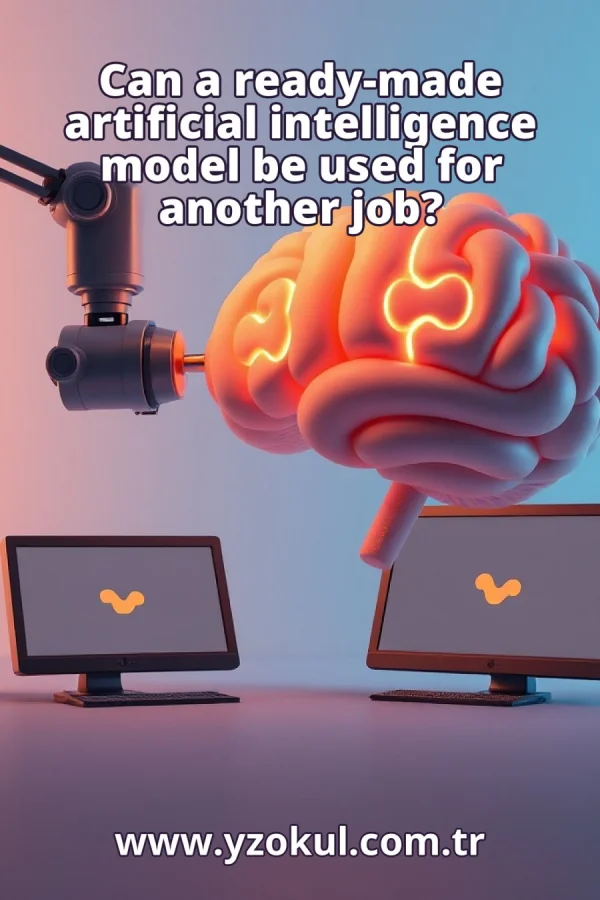
Can a ready-made artificial intelligence model be used for another job?
www.yzokul.com.tr
- Category AI Resources
- Format PDF
- Size 7.3 MB
- Added 01.11.2026
- Views 1
This book answers whether a ready-made artificial intelligence model can be used for another job. It explains that this is possible through transfer learning: features learned for one task can help with a similar new task, so you may not need to start from scratch. Using a model trained on general images to recognize specific products is one example. The book also notes that if the new task differs greatly from the original training, the benefit may shrink, and suitable data and evaluation are still needed.
Read the Book
If the PDF does not appear, open it in a new tab.
A Chapter from the Book
Can a ready-made artificial intelligence model be used for another job? www.yzokul.com.tr
You may wonder whether a ready-made artificial intelligence model can be used for a different job. The short answer is yes, often, through a method called transfer learning. Transfer learning means taking what a model has already learned and applying it to a new but related task. This book explains how that works step by step, so you can see when and how to reuse a model. 1
An artificial intelligence model is a computer program that has learned patterns from examples. It takes an input, such as a picture, and produces an output, such as a label like cat or dog. The model does not follow hand-written rules for every case; instead, it generalizes from what it has seen. This ability to turn input into output is what makes a model useful for a job. 2
Training means showing a model many examples so it can find patterns. For instance, you show it thousands of labeled pictures of cats and dogs, and it gradually learns what distinguishes them. The result of training is a set of learned features stored inside the model. These features capture the important regularities in the examples, and they are what the model uses to make predictions later. 3
Features are the useful patterns a model picks up from examples. In images, features might be edges, shapes, or textures. In text, they might be common word combinations or sentence structures. Features are the model's internal knowledge, and they are stored as numbers inside the model. Good features make it easier for the model to solve the task it was trained on. 4
Many ready-made models already exist and are shared publicly. You can download them and use them without building or training one from zero. These models have been trained on large datasets and have learned rich features. Using a ready-made model can save you a lot of time and computing resources, especially if you are a beginner. 5
Picture a model trained for one job, such as recognizing general objects in photos, like cars, trees, and people. Now you want it to do a different but related job, such as spotting specific products on a store shelf. The two jobs are not identical, but they both involve recognizing visual patterns. This is the kind of situation where reusing a model can help. 6
Features learned for the first job can still be useful for the second job. For example, a model that learned to detect edges and shapes in general images can use those same features to recognize product outlines. This reuse of learned features is the core idea of transfer learning. It means you do not have to teach the model everything from the beginning. 7
Transfer learning means taking knowledge from one task and applying it to a similar new task. In plain words, you start with a model that already knows something useful, and you adjust it for your new job. This approach saves time and effort because the model does not need to learn basic patterns again. It builds on what is already there. 8
Consider a model trained on general images, like photos of everyday scenes. You want to adapt it to tell specific products apart, such as different brands of cereal. The early learned patterns, like edges and simple shapes, still help because products also have edges and shapes. You then train the model a bit more on your product images so it can specialize. 9
With transfer learning, you may not need to start from scratch. Instead of training a new model from random initial values, you begin with a model that already has useful features. You adjust the existing model, often by training it further on your new data. This can lead to good results with less data and less time than building from zero. 10
Transfer works best when the old and new tasks are alike. If both tasks involve similar kinds of input, such as images of objects, the shared patterns carry over and give a real head start. For example, a model trained on general images transfers well to recognizing specific products because both involve visual shapes and textures. The more similar the tasks, the stronger the benefit. 11
If the new task differs greatly from the original training, the benefit may shrink. For instance, a model trained on photos of animals may not transfer well to reading medical X-rays, because the visual patterns are very different. The old features may no longer fit well, and you might need more new data or a different approach. The gap between tasks matters. 12
Even with a ready-made model, you still need suitable data for the new job. Data shows the model what the new task looks like, including the specific examples and labels it must learn. Without relevant data, the model cannot adapt its features to your problem. Collect a dataset that represents the new job as closely as possible. 13
You must check how well the adapted model performs on the new task. Testing on new examples that the model has not seen during training tells you if it truly works. Use a separate test set to measure accuracy and catch problems like overfitting. Evaluation is essential because a model that looks good on training data may fail on real new data.
This section is a preview taken from the book (about 901 words). To continue, read the book or download the PDF.
Book Details
- Book
- Can a ready-made artificial intelligence model be used for another job?
- Author
- www.yzokul.com.tr
- Category
- AI Resources
- Language
- English
- Format
- PDF · 7.3 MB
- Pages
- 18
- Words
- about 1,023
- Published
- kaynak.yzokul.com.tr · 01.11.2026
- Access
- Free to read and download; for personal use only, all rights belong to the author.
Frequently Asked Questions
Is the PDF of Can a ready-made artificial intelligence model be used for another job? free?
Yes. Can a ready-made artificial intelligence model be used for another job? can be read and downloaded for free on this site; no sign-up or payment is required.
How many pages is Can a ready-made artificial intelligence model be used for another job??
Can a ready-made artificial intelligence model be used for another job? has 18 pages and about 1,023 words.
Which devices can I read Can a ready-made artificial intelligence model be used for another job? on?
It is a PDF; you can read it in your browser on a phone, tablet or computer, or download it and open it offline.
Who is the author of Can a ready-made artificial intelligence model be used for another job??
Can a ready-made artificial intelligence model be used for another job? was written by www.yzokul.com.tr; it is listed in the AI Resources category.
Similar Books
 What is artificial intelligence?
www.yzokul.com.tr
 How does an app idea turn into a working program?
www.yzokul.com.tr
 What is the difference between virtual reality and augmented reality?
www.yzokul.com.tr
 How does a three-dimensional printer produce a model?
www.yzokul.com.tr
 What is simulation?
www.yzokul.com.tr
 How does a robot find the shortest path?
www.yzokul.com.tr