
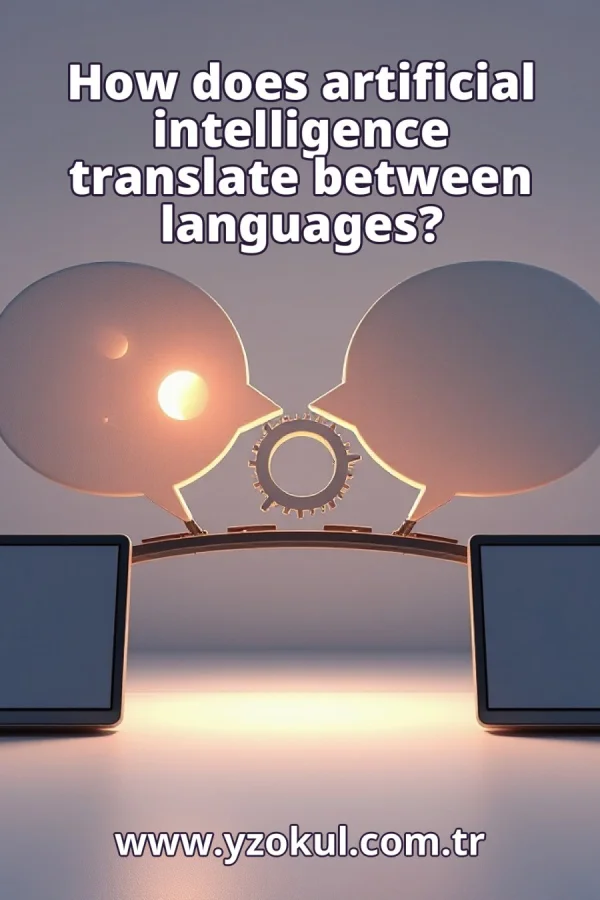
How does artificial intelligence translate between languages?
www.yzokul.com.tr
- Category AI Resources
- Format PDF
- Size 7.8 MB
- Added 01.11.2026
- Views 2
This book answers the question of how artificial intelligence translates between languages. It follows a beginner-friendly path that starts from zero and explains that translation models do not simply replace words one by one. They also consider word order, context and idioms, since a word-for-word translation of an idiom can cause misunderstanding. The model learns suitable equivalents from examples, and human supervision can still help with ambiguous or culture-specific expressions.
Read the Book
If the PDF does not appear, open it in a new tab.
A Chapter from the Book
How does artificial intelligence translate between languages? www.yzokul.com.tr
Artificial intelligence can translate text from one language to another, and the short answer is that it does not just swap words one by one. A translation model also uses word order, context and idioms to build a fitting sentence in the other language. It works with the meaning of the whole text, not with isolated words. This book explains each part of that process in order. 1
Translation means carrying the meaning of a text from one language into another. The goal is a sentence that means the same thing as the original, not a copy of the same words. Two sentences can share meaning even when they share no words at all. Keep this goal in mind: meaning is what travels between languages, and words are only the tools that carry it. 2
Replace each word of a simple sentence with its partner word in another language, and the result often sounds broken or wrong. Single words are not enough on their own because they carry only part of the meaning. A list of swapped words can lose the connections between them. This is why translation needs more than a dictionary lookup. 3
Languages put words in different orders, so a translation model must rearrange them. A correct set of words in the wrong order can still confuse the reader or change the emphasis. For example, one language may place the verb near the end and another near the beginning. The model learns the usual order of each language from examples. 4
The same word can mean different things depending on the sentence around it. A model reads the whole sentence to pick the right meaning before it chooses a word in the target language. For example, a word for a bank of a river is not the same as a bank for money. Context tells the model which sense is meant. 5
An idiom is a fixed phrase whose meaning is not built from its single words. Translating an idiom word for word can create a misunderstanding or nonsense. Instead, the model looks for the matching idiom or phrase in the target language. If no close match exists, it expresses the meaning in plain words. 6
A translation model learns suitable equivalents by studying many example translations. From these examples it picks up patterns of how each language expresses meaning, including word order and common phrases. It is not given a rule for every word pair. The patterns it learns let it produce fitting sentences for new texts it has not seen. 7
To translate, the model takes in the source sentence and works out how its words relate to each other. This relationship map shows which word modifies which, and what the main action is. The model uses this map, not the raw word list, as its guide. Building the map is how it captures context and structure. 8
From those relationships, the model turns the meaning into a fitting expression in the target language. It builds the new sentence piece by piece rather than copying words across. Each piece is chosen to fit the meaning and the grammar of the target language. The output should read naturally to a speaker of that language. 9
Some expressions are ambiguous, and some are tied closely to one culture. For these, human supervision can still be useful: a person checks the meaning the model cannot be sure about. A human can confirm the intended sense or suggest a better equivalent. The model does the bulk of the work, and people help where doubt remains. 10
A phrase tied to one culture may have no direct match in another language. For example, a traditional greeting or a food name may carry associations that do not exist elsewhere. The model offers the closest fitting equivalent it has learned. A human then checks whether that choice carries the right feeling and meaning. 11
A common mistake is assuming each word has exactly one partner word in the other language. Real translation often needs several words, or different ones, to carry the same meaning. One word in the source may become a phrase in the target, and the reverse also happens. Treat word pairs as hints, not as fixed rules. 12
Another common mistake is translating a word without its surrounding sentence. Without context, the model could pick the wrong meaning of an ambiguous word. Always read the full sentence before judging a translation choice. The surrounding words are what tell you which sense was intended. 13
Translating idioms literally is a frequent mistake, and it misleads readers who expect the phrase to mean what it usually means. The fix is to use the learned equivalent instead of the literal words. When no equivalent exists, express the meaning plainly. Check that the idiom still makes sense to a reader of the target language. 14
Read the model's output as a whole to see whether the meaning carried over. Ask whether a reader of the target language would understand the same thing as a reader of the original. If something is unclear or culture-bound, a human can still step in and adjust it. Checking the whole text catches problems that single words hide. 15
Artificial intelligence translates by working with meaning, not single words: it uses word order, context and idioms, and it learns suitable equivalents from many examples. For unclear or culture-specific cases, human supervision can still help. The key point to remember is that meaning is what gets translated, and the words are chosen to carry it.
This section is a preview taken from the book (about 934 words). To continue, read the book or download the PDF.
Book Details
- Book
- How does artificial intelligence translate between languages?
- Author
- www.yzokul.com.tr
- Category
- AI Resources
- Language
- English
- Format
- PDF · 7.8 MB
- Pages
- 18
- Words
- about 935
- Published
- kaynak.yzokul.com.tr · 01.11.2026
- Access
- Free to read and download; for personal use only, all rights belong to the author.
Frequently Asked Questions
Is the PDF of How does artificial intelligence translate between languages? free?
Yes. How does artificial intelligence translate between languages? can be read and downloaded for free on this site; no sign-up or payment is required.
How many pages is How does artificial intelligence translate between languages??
How does artificial intelligence translate between languages? has 18 pages and about 935 words.
Which devices can I read How does artificial intelligence translate between languages? on?
It is a PDF; you can read it in your browser on a phone, tablet or computer, or download it and open it offline.
Who is the author of How does artificial intelligence translate between languages??
How does artificial intelligence translate between languages? was written by www.yzokul.com.tr; it is listed in the AI Resources category.
Similar Books
 What is artificial intelligence?
www.yzokul.com.tr
 How does an app idea turn into a working program?
www.yzokul.com.tr
 What is the difference between virtual reality and augmented reality?
www.yzokul.com.tr
 How does a three-dimensional printer produce a model?
www.yzokul.com.tr
 What is the Internet of Things?
www.yzokul.com.tr
 What is simulation?
www.yzokul.com.tr