
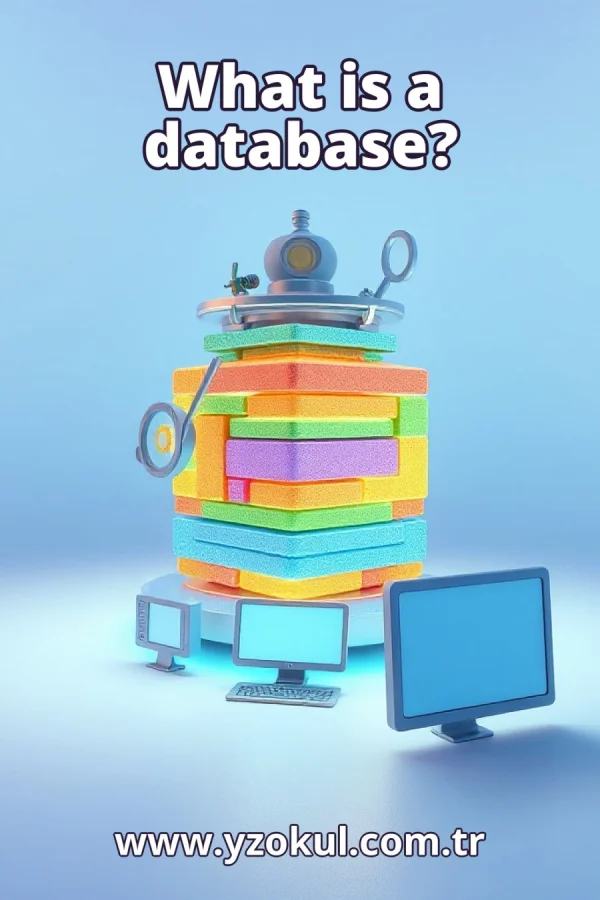
What is a database?
www.yzokul.com.tr
- Category AI Resources
- Format PDF
- Size 8.7 MB
- Added 01.11.2026
- Views 2
This book answers the question of what a database is for complete beginners with no prior knowledge. It follows a simple path: first it explains that a database stores information in an organized way and lets you find and change it when needed, using examples like student records, products, or game results. Then it introduces the data management system that controls access and operations, shows how easy queries work, and ends by stressing that a database is not just a pile of files but a system with organized access rules.
Read the Book
If the PDF does not appear, open it in a new tab.
A Chapter from the Book
What is a database? www.yzokul.com.tr
A database is a structure that stores information in an organized way and lets you find and change it when needed. That one sentence is the short answer to the question. The goal of this book is to explain each part of that answer plainly, from zero, with simple examples like student records, shop products, or game results. By the end you will know what a database is and what it is not. 1
Picture a messy pile of student papers on a desk. Finding one name means lifting and reading paper after paper, and it takes forever. Nothing is labeled, so you cannot tell where anything is. Storing information without organization causes trouble like this. The pile holds data, but it does not help you use it. 2
Now picture the same papers sorted into labeled folders and placed on shelves, so each item has a clear place. One folder for each class, one paper for each student, all in order. This is the first idea of a database: information kept in an organized structure. The labels and folders are the structure that makes the information usable. 3
Organized storage lets you find a specific item quickly when you need it. If each student paper sits in a labeled folder, you go straight to the right folder instead of searching the whole pile. Finding is the second job of a database, after storing. A database is built so that a single record can be located without reading everything else. 4
Information changes over time, and a database lets you change it. Suppose a student moves and their address is different. In the organized store, you open that student's record and update the address in its place. Changing information when needed is the third job of a database. The old value is replaced, and the record stays correct. 5
Take student records as a simple example. Each student has one record with fields such as name, class, and address. The records together form the stored information of the database. Because every record has the same fields in the same places, the whole set stays consistent. You can add a new student by adding one new record. 6
The same idea works for many kinds of information. A shop keeps its products in a database: each product has a record with name, price, and stock. A game keeps its results there too: each player's score is one record. Organized storage is not only for schools. Any collection that must be found and changed benefits from it. 7
The part that manages access to the information is called a database management system. It sits between you and the stored information. You do not touch the records directly; you ask the management system, and it performs the operation. It handles storing, finding, changing, and the rules about who may do what. This is what makes a database a system, not just a container. 8
Access rules matter because not everyone should see or change everything. The management system decides who may look at which records and who may change them. For example, a teacher may change grades while a student may only view their own. Organized access rules keep the information safe and consistent. They prevent accidental or unauthorized changes. 9
Asking for information is called a query: a request for records that match a condition. Suppose you want the students in a particular class. You tell the management system the condition, and it searches the stored records for matches. You do not sort through everything yourself. The management system does the work and returns only what fits. 10
The answer to the class query comes back as a short list of matching students. Each row is one student's record, showing the fields you asked for. The list is exactly the students in that class, nothing more. This shows how easy it is to get information out of an organized database. A clear question gets a clear, complete result. 11
A database is not just a big pile of files. A pile has no rules: no labels, no shared fields, no control over who changes what. A database has structure, so every record fits the same pattern, and it has organized access rules. That structure and those rules are what let you find and change information reliably. The difference is organization, not size. 12
Compare the two side by side. The pile is unsorted and hard to search, and two people may hold different versions of the same paper. The database is organized and easy to query, and each record has one correct place. This clears up the most common misunderstanding. A database is defined by its structure and access rules, not by how much it holds. 13
A common mistake is thinking a database is only a place to keep data. Storing is just the first job. A database also finds data when you query it and changes data when records are updated. And it enforces access rules through the management system. Keeping, finding, changing, and controlling access work together. That combination is what a database is. 14
Another common mistake is thinking a database is one giant file. It is not a single file but a system with organized structure and rules for access. The management system coordinates the records, the queries, and the permissions. Records are organized by shared fields, not crammed together without order. Thinking of it as a system, not a file, keeps the idea correct.
This section is a preview taken from the book (about 923 words). To continue, read the book or download the PDF.
Book Details
- Book
- What is a database?
- Author
- www.yzokul.com.tr
- Category
- AI Resources
- Language
- English
- Format
- PDF · 8.7 MB
- Pages
- 18
- Words
- about 992
- Published
- kaynak.yzokul.com.tr · 01.11.2026
- Access
- Free to read and download; for personal use only, all rights belong to the author.
Frequently Asked Questions
Is the PDF of What is a database? free?
Yes. What is a database? can be read and downloaded for free on this site; no sign-up or payment is required.
How many pages is What is a database??
What is a database? has 18 pages and about 992 words.
Which devices can I read What is a database? on?
It is a PDF; you can read it in your browser on a phone, tablet or computer, or download it and open it offline.
Who is the author of What is a database??
What is a database? was written by www.yzokul.com.tr; it is listed in the AI Resources category.
Similar Books
 What is artificial intelligence?
www.yzokul.com.tr
 How does an app idea turn into a working program?
www.yzokul.com.tr
 What is the difference between virtual reality and augmented reality?
www.yzokul.com.tr
 How does a three-dimensional printer produce a model?
www.yzokul.com.tr
 What is the Internet of Things?
www.yzokul.com.tr
 What is simulation?
www.yzokul.com.tr