
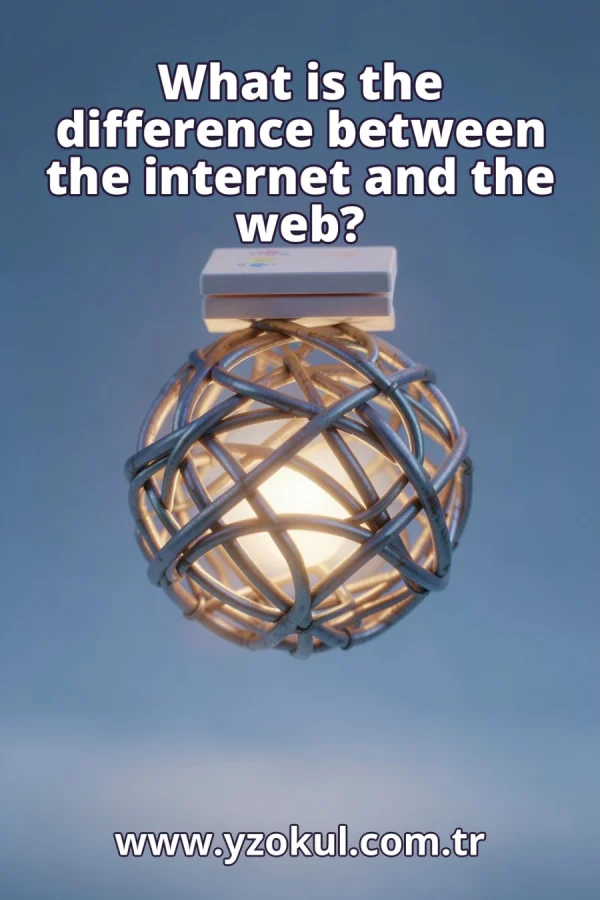
What is the difference between the internet and the web?
www.yzokul.com.tr
- Category AI Resources
- Format PDF
- Size 7.1 MB
- Added 01.11.2026
- Views 2
This beginner-friendly answer book explains the difference between the internet and the web from zero, assuming no prior knowledge. It answers the question of how these two commonly confused terms differ. The book follows a clear path: it first describes the internet as the general communication infrastructure connecting devices and networks, then presents the web as one service of pages and resources accessed through browsers. It notes that email and some game connections use the internet without being web pages, and uses a road network comparison to make the distinction easy to grasp.
Read the Book
If the PDF does not appear, open it in a new tab.
A Chapter from the Book
What is the difference between the internet and the web? www.yzokul.com.tr
You have probably heard people use the words internet and web as if they mean the same thing. They are not the same. The internet is the connecting infrastructure that lets devices and networks talk to each other. The web is just one service that runs on top of that infrastructure. Keep this headline distinction in mind as you read on. 1
People often say internet when they mean web, and web when they mean internet. This habit causes confusion in everyday conversation, in news reports, and even in technical help desks. Clearing up the difference matters because it helps you understand what is actually broken when something stops working. It also helps you describe technology more accurately to others. 2
The internet is the general communication infrastructure that connects devices and networks to each other. It is not a set of pages or a place you visit. It is the underlying system that lets data travel between machines, whether those machines are phones, computers, or servers. Think of it as the plumbing that carries information from one point to another. 3
Picture many devices, such as phones, laptops, and desktop computers, linked so they can send information back and forth. The key idea is connection between machines. There is nothing here about content, pages, or websites yet. The internet is simply the arrangement that allows one device to exchange data with another, no matter where they are. 4
The internet is not one single network. It is many separate networks joined together so they can pass data along to each other. Your home network connects to your provider's network, which connects to others, forming a vast web of connections. This is why the internet is called an infrastructure rather than a service. It is the foundation that many services rely on. 5
The web is the service formed by pages and resources that you open with a browser. A browser is a program like Chrome, Firefox, or Safari that displays web pages. The web is something you use on top of the internet, not the internet itself. When you click a link and a page appears, you are using the web, which travels over the internet. 6
A browser window shows pages with text, images, and links. That experience is the web. The browser is the tool that reaches web pages over the internet. You type an address or click a link, and the browser fetches the page for you. The page itself is a resource stored on a computer somewhere, delivered to you through the internet. 7
The web sits on top of the internet. The pages travel over the infrastructure just as cars travel over roads. This means the web needs the internet to work, but the internet is bigger than the web. The internet can carry many kinds of traffic, and the web is only one kind. Without the internet, the web could not function at all. 8
Email uses the internet but does not have to be a web page. When you send an email, your message travels across the internet to reach another person. You might read it in a browser, but the email itself is not a web page. This is the first concrete example that the internet carries more than just the web. Email is a separate service on the same infrastructure. 9
Some game connections also use the internet without being web pages. When you play an online game, your device exchanges data with game servers over the internet. That data is not a web page you browse. This adds a second example showing the internet serves many kinds of traffic. Games, like email, rely on the internet but are not part of the web. 10
Compare the internet to a road network and the web to one specific delivery service that uses those roads. The roads exist for many uses: trucks, cars, buses, and bicycles. The delivery service is just one of them. In the same way, the internet is the road network, and the web is one service that runs on it. Other services use the same roads too. 11
Extend the road picture: email, games, and the web are different services all sharing the same roads. Email is like a postal service, games are like a racing event, and the web is like a delivery company. They all use the same road network but for different purposes. This makes the one infrastructure, many uses idea easy to hold. 12
The web is not the whole internet but one of its areas of use. This is the core takeaway. The internet is the infrastructure, and the web is a service of pages accessed through a browser. Email and games are other areas of use. Keeping this in mind helps you avoid the common confusion between the two terms. 13
A common mistake is treating the internet and the web as identical. People say the internet is down when only one website fails to load. Correct this by recalling that the web is a service running on the internet. The internet may still be working fine even if a particular website is unavailable. Naming which one you mean makes your description accurate. 14
Check a second slip: saying the internet is down when only a website fails, or the reverse. If your browser cannot open a page, the website might be down while the internet works. If email also fails, the internet connection might be the problem. Learn to name which one you actually mean. This small habit prevents much confusion.
This section is a preview taken from the book (about 942 words). To continue, read the book or download the PDF.
Book Details
- Book
- What is the difference between the internet and the web?
- Author
- www.yzokul.com.tr
- Category
- AI Resources
- Language
- English
- Format
- PDF · 7.1 MB
- Pages
- 18
- Words
- about 1,002
- Published
- kaynak.yzokul.com.tr · 01.11.2026
- Access
- Free to read and download; for personal use only, all rights belong to the author.
Frequently Asked Questions
Is the PDF of What is the difference between the internet and the web? free?
Yes. What is the difference between the internet and the web? can be read and downloaded for free on this site; no sign-up or payment is required.
How many pages is What is the difference between the internet and the web??
What is the difference between the internet and the web? has 18 pages and about 1,002 words.
Which devices can I read What is the difference between the internet and the web? on?
It is a PDF; you can read it in your browser on a phone, tablet or computer, or download it and open it offline.
Who is the author of What is the difference between the internet and the web??
What is the difference between the internet and the web? was written by www.yzokul.com.tr; it is listed in the AI Resources category.
Similar Books
 What is artificial intelligence?
www.yzokul.com.tr
 How does an app idea turn into a working program?
www.yzokul.com.tr
 What is the difference between virtual reality and augmented reality?
www.yzokul.com.tr
 How does a three-dimensional printer produce a model?
www.yzokul.com.tr
 What is simulation?
www.yzokul.com.tr
 How does a robot find the shortest path?
www.yzokul.com.tr